Showing posts with label books for boys. Show all posts

Saturday, January 11, 2025

WHERE TO HIDE A STAR


By Oliver Jeffers 


(HarperCollins, 2024)


I have been a fan of Oliver Jeffers’ picture books since I discovered The Incredible Book Eating Boy which I read to countless classes and parent groups. (It’s one of the first picture books I blogged about.) That book celebrates an unorthodox love of books and a hunger for knowledge. (Yes, the title should be taken literally.) Since then, Jeffers has continued to produce whimsical, zany stories that always make me do a double take before a broad smile covers my face.


Where to Hide a Star 
is his latest amusing, satisfyingly off-kilter tale. It begins as the story of a boy and his two friends—a penguin and a star, naturally. (Yes, cue double take.) The boy and his friends love to play hide-and-seek, the boy always being It “as he was the only one who could count.” During one game, the star goes missing. Worried, the boy seeks help from a Martian (of course).


In the meantime, the star is discovered by a girl who, lo and behold, has always dreamed of befriending a star. When the boy shows up, it’s awkward. “They both wanted the star, but they didn’t want to make someone else unhappy.”


Precious. 


At this point, the story is similar to Jeffers’ This Moose Belongs to Me. But then it’s decided that the Martian will assist the star in hiding, the presumption being that whoever finds it shall claim primary friendship rights. 


I’ll leave you to discover the ending yourself.


At this point, Jeffers’ books are—to borrow a term stirred up from his Book Eating Boy days—comfort food. I always know I’m going to enjoy them. I love the familiarity of his simple illustration style with boxy bodies, stick figure appendages, and warm background colors. I know I’m going to read each book again, the first read focused on quirks, the follow-ups taking in the entire project, sometimes picking up a missed quirk. 
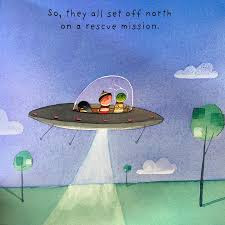


With Where to Hide a Star, Jeffers’ winning streak continues.


Sunday, November 24, 2024

JOHN'S TURN


By Mac Barnett


Illustrated by Kate Berube


(Candlewick Press, 2022)


I checked this book out of my local library based on the writer’s name and the cover image. Mac Barnett is a clever, sparkly writer of children’s books like Sam and Dave Dig a Hole and Count the Monkeys. I figured I could use some amusement. But this isn’t that kind of book. (More on the cover in a bit.)


The book focuses on a regular feature of a school’s Friday morning assemblies. At the end, one student performs a special talent, such as playing the tuba, performing magic tricks or doing stand-up. This Friday, as the title notes, it’s John’s turn. 


At breakfast in the school cafeteria, John doesn’t look so good. The students around him eat, chat and laugh. John does none of that. He’s got a case of the nerves. Later, backstage, he changes into a white leotard, black pants and slippers. He sits, anticipating his performance, still looking nervous as the assembly proceeds through its normal agenda items:

                            Mr. Ross reminded us permission slips

                            were due Monday. We all sang a song.


At last, it’s time for John.


                            “What’s John gonna do?”

                            Andre asked without raising his hand.

                            Mr. Ross looked at his paper.

                            “He’s doing a dance.”

                            “Cool,” Andre said.

                            He never raises his hand. 


There’s always an Andre. And the fact there is, makes the reader worry a little for John. This is unlikely to be Andre’s (and others’) version of a cool dance. 


John dances. Neither John’s movements nor the music—“strings, violins and things”—is familiar. Kids laugh.


But they stop when shushed. John commits and, yes, he shines. He takes a bow. How will his peers respond? The ending, of course, is how we want things to go for every young John, daring to be different, sharing his true passion.


Bravo!   


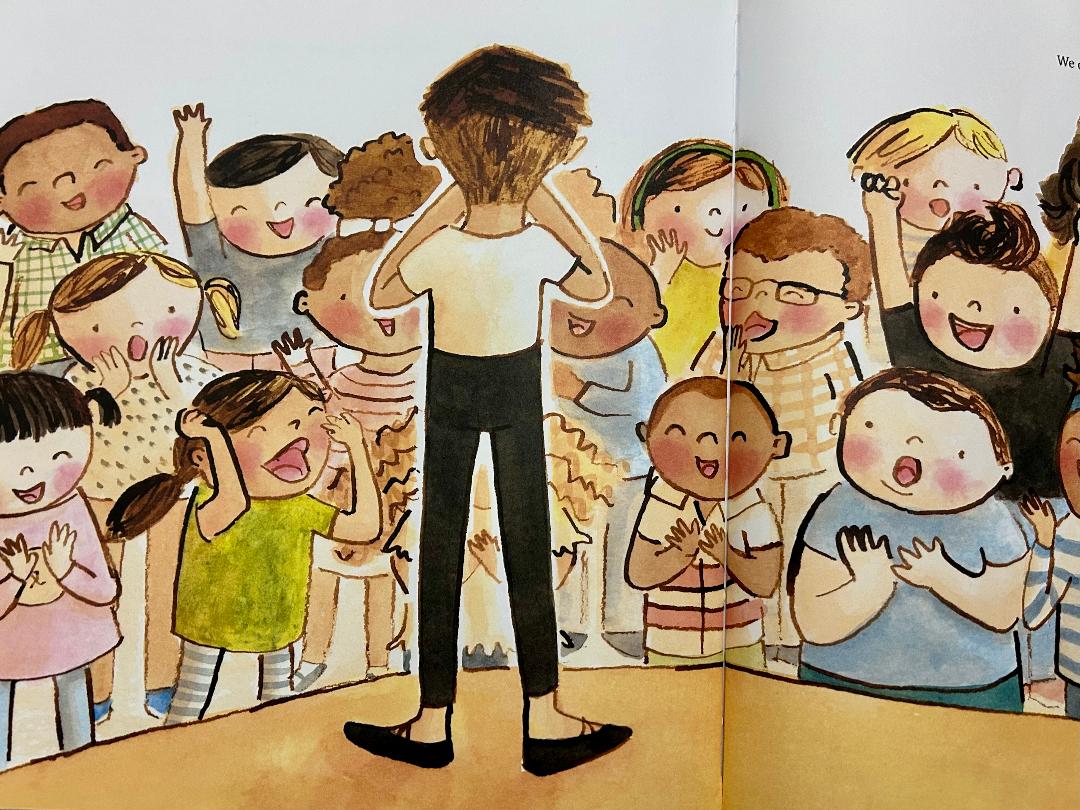
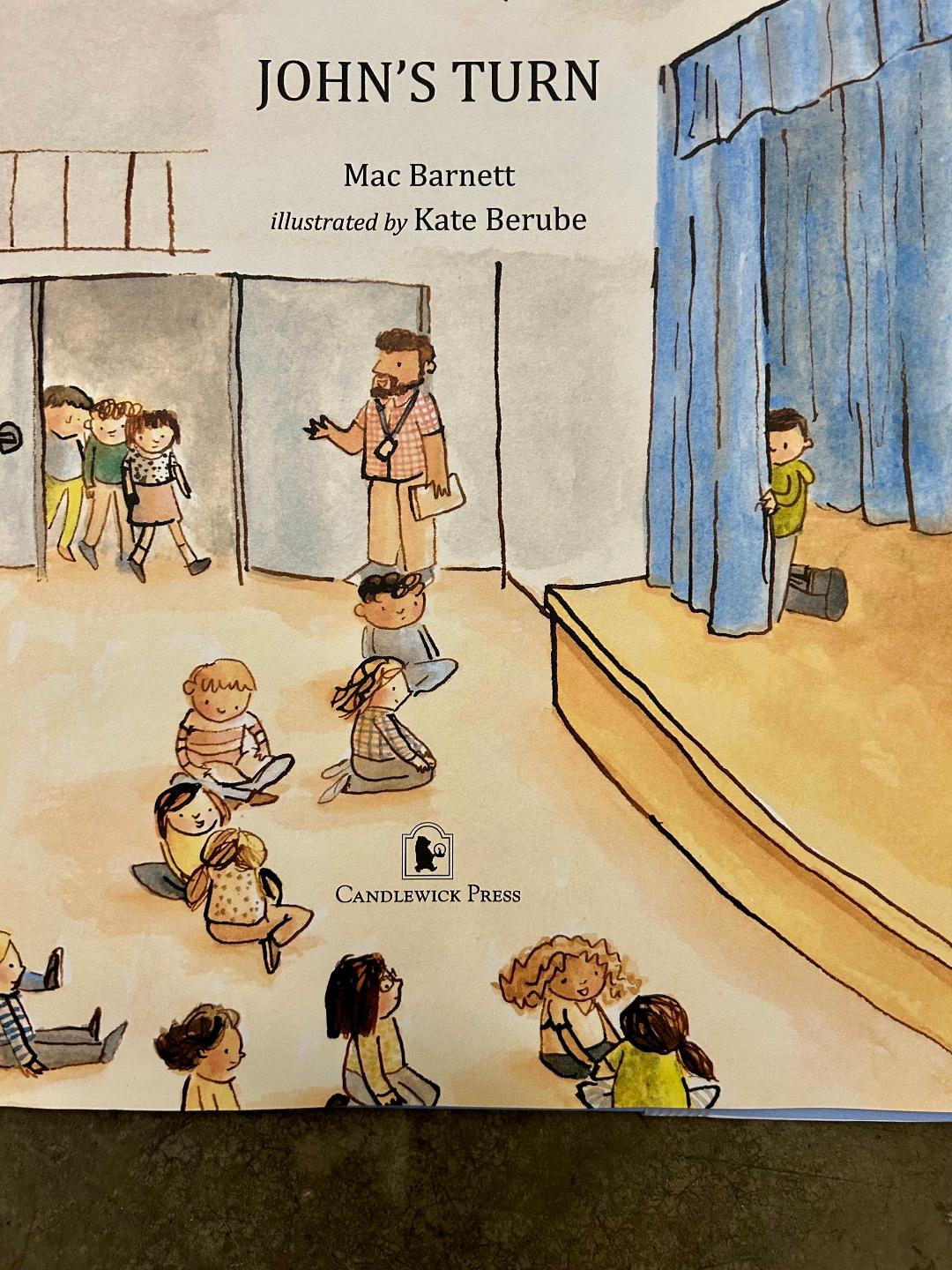
I do have a quibble over the cover. I admit the image of a young boy in ballet gear, complete with pointe shoes, drew me in. I knew this kid book would be different. I figured it would confront stereotypes and traditional gender roles. As an adult, I saw the cover’s message: Very Special Book. But, for kids, the cover may make them giggle—boys, especially—and steer clear of picking it up. I would have preferred an image of John’s face nervously peeking through a stage curtain at the expectant audience. Indeed, there’s a suggestion of this in part of the title page. Given that the book avoids mentioning John’s talent right away, the cover is also a spoiler, making the reveal less dramatic.


On my second time paging through the book, I focused on Kate Berube’s illustrations, done with ink and paint on cold-pressed watercolor paper. She skillfully depicts each scene. The title page shows students gathering in the open assembly room (aka the cafeteria), some finishing up breakfast, some chatting, some seated facing the stage, ready for what’s to come, one intently reading a book in his lap. 


Whenever Mr. Ross talks, there’s at least one audience member talking to a neighbor. By contrast, when a student performs, the students give them full attention.


And then comes John’s turn. Classical music plays and the students look bored, skeptical; one looks primed to heckle. John looks like he’d rather be anywhere else, his face full of angst. His face is tentative during his first moves.


And then… 


In a double-page spread, Berube depicts six stages of one grand leap and we see John’s face change from worried and cautious to proud and accomplished. From that point on, there is no turning back. John is in his element.  


This is a well-told story and a highly useful book to share with children before talent shows or any school assembly when students or a theater/dance group performs. It’s also a great conversation starter about following one’s interests no matter what the peanut gallery might say or do. Pot-shots are easy. Sometimes they come when someone feels uneasy, the subject matter unfamiliar. Sometimes they arise from a desire to mock. There will always be critics. 


Let John and boys like John dance on.


Tuesday, February 5, 2019

WILD THINGS

PETUNIA GOES WILD
By Paul Schmid
(Harper, 2012)


WILD FEELINGS
By David Milgrim
(Henry Holt and Company, 2015)

Kids easily connect to wild animals. Running around, roaring and growling, is incredibly freeing. (Why did we ever stop?)

I’m a big fan of Paul Schmid’s Petunia. I first discovered her in the delightful A Pet for Petunia when she begged and begged her parents for a pet skunk. As a teacher and principal, I often carried the book from classroom to classroom, one of my Stack of Five. (I do a quick book talk about five picture books and then let the audience vote to determine which one I read aloud during the visit.) Sadly, the book was rarely chosen no matter how much I talked it up.

It seems Petunia is an in-between character. On the cover of each book, she wears a purple and white striped dress. Sadly, I suspect that the color and her gender caused many of the boys in class to withhold their vote. They say boys are less inclined to warm up to books with girls as the main character; I’m intent on changing that. I think many of the girls don’t vote to hear about Petunia because she’s not stereotypically girlish. She’s more Olivia (the pig) than Belle (the princess).

I often read A Pet for Petunia as a “bonus read” after the top vote getter. (“But it didn’t even come in second,” someone always says. Ah, let’s expand our horizons.)

Like it’s predecessor, Petunia Goes Wild works best as a read-aloud when you’ve read it to yourself a couple of times. You want to nail the part of Petunia. There are stereotypes to be broken, after all. Petunia has a stuffed animal that’s a lion and—no, she doesn’t want a pet lion this time around. Rather, Petunia is a lion. She roars at passersby from the front yard, she crawls and eats from the floor, she even bathes in a mud puddle. So very lion-ly.

For a parent, all this feral, feline behavior can be problematic. As in A Pet for Petunia our feisty, persistent main character eventually drives her parents to utter exasperation. There is an incredibly wordy page that is the most fun to read out loud. It’s a classic parental rant.

And, as a read-aloud, at least, kids love it. They all have parents who’ve succumbed to a rant.

Petunia is both genuinely funny and wildly imaginative.

The cover photo of David Milgrim’s Wild Feelings shows the main character—a boy this time—dressed as a lion, mouth agape in full roar. Milgrim goes through a series of familiar similes, comparing feelings to animals.

Do you ever feel...
as stubborn as a mule?

Or as chicken
as a chicken?

This is a book for kids—especially boys—to connect with a range of often negatively viewed feelings. It’s a springboard for talking about them and normalizing them.

So what’s an acceptable thing to do when you’re “rrrrrreally mad”? How do you recover when it’s all over, when perhaps things didn’t go so smoothly while you were in the midst of the mood?

Picture books like this not only entertain, but they open the door for talking about more difficult things. They can be reference points after the fact as well. (Remember that book we read about...?) If kids can name their feelings and talk about them, the “bad” feelings won’t go away but they’ll learn how to work through them (more appropriately over a period of time). They’ll also give their temperamental friends some support and/or space when they’re in such a mood.

I’m wild about both these books. Track them down and have a roaring good time sharing them with the kids closest to you.

Thursday, January 2, 2014

SHARK VS. TRAIN

Written by Chris Barton

Illustrated by Tom Lichtenheld

(Little, Brown and Company, 2010)

Preposterous, right? Under what circumstances would a shark compete against a train? You only have to spend an hour with a couple of boys and a box full of toys to see the possibilities. Indeed, that is where the standoff begins in this book. Even before the title page, two boys rush to the toy box, one selecting the toy shark (“GRRRRR”), the other choosing the choo-choo (“CHUGRRR-CHUG”). It’s a battle to the finish...or until the next distraction comes along.

I love this clever, absurd book. It celebrates boys’ imaginations and the shenanigans that can only come from free, unstructured play. Shark and train compete in a variety of situations. Some favor the shark—the hot-air balloon ride, for example. Unfortunately, train is deadweight.
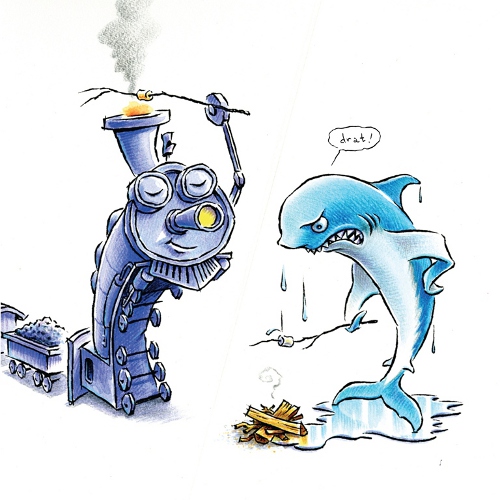
My favorite of Tom Lichtenheld’s illustrations portrays advantage train as the two characters roast marshmallows. The locomotive smiles contentedly—perhaps a tad smugly—as it browns the treat with its engine. By contrast, poor shark can’t keep a fire going as he keeps dripping over the kindling. “Drat” indeed!

The situations get even sillier—sword fighting on a tightrope, space travel—just the way children’s play evolves. Younger children will be drawn to the illustrations and the expressions on the toys’ faces. Older children will appreciate the edgier humor such as when shark dons a party hat, goes trick-or-treating and says to the person with a bowl of candy at the door, “This clown is very hungry.” Oh, my!

I am a huge fan of Tom Lichtenheld’s work. (By golly, my last post just so happens to be another picture book that he illustrated.) He gives the viewer a little something extra as train’s distinct little red caboose doesn’t always chug along so well with the rest of the procession. The caboose reminds me of the tiny cloud in his delightful Cloudette. And, yes, I will be looking for more from author Chris Barton. For now, I cannot wait to take Shark vs. Train on a tour as a read-aloud in classrooms at school.

It does not matter who wins these goofy battles between the two toys. The true winner is the reader.

Monday, December 30, 2013

GOODNIGHT, GOODNIGHT, CONSTRUCTION SITE

Written by Sherri Duskey Rinker

Illustrated by Tom Lichtenheld

(Chronicle Books, 2011)

If Goodnight Moon and Mike Mulligan and His Steam Shovelbore a picture book child, this would be it. This is a bedtime story for little ones who pass the day digging and building in sandboxes with tough trucks that create, demolish and rebound all to a soundtrack of animated whirrs and booms.

There is a time when construction workers, both young and old, must call it a day and when, as imagined by author Rinker, the powerful vehicles must shut down for the night.

The sun has set, the work is done;

It’s time for trucks to end their fun.

So one by one they’ll go to bed

To yawn and rest their sleepy heads


Her rhyming tale features the day’s end rituals of Crane Truck, Cement Mixer, Dump Truck, Bulldozer and Excavator. Illustrated by Tom Lichtenheld, each vehicle takes on a human quality as front windows or headlights become eyes and front hoods transform to mouths. When each engine shuts off, the reader says, Shh...goodnight, ________, goodnight.

My favorite illustration shows Crane Truck asleep while clutching a teddy bear as a shining star acts as a nightlight dangling from the boom hook. Having tossed and turned through a restless sleep last night, I feel complete envy for this endearingly sweet image.

No doubt, this will be a popular read night after night. I can envision parent and child whispering goodnight to each truck before the parent provides the final tucks and bids the child, “Shh...goodnight, _____, goodnight.” And,...lights out.

Who knows what construction projects await in the little one’s dreams?!

Friday, June 7, 2013

STANLEY'S STICK


Written by John Hegley

Illustrated by Neal Layton

(Hodder Children’s Books, 2011)

Often when I take my dog for a walk in the woods or along the beach, we’ll encounter another dog, trotting contentedly with a stick in its mouth. The dog’s expression conveys sheer joy. Such a simple toy. (My dog engages in stick play only fleetingly. It is an unworthy substitute for human interaction.)
When Legos and computer games are pushed aside, children can also find sticks to be amusing springboards for the imagination. Antoinette Portis captured this notion in the simply written and illustrated Not a Stick (a follow-up to Not a Box).

Stanley’s Stick by John Hegley and Neal Layton expands on this theme. It highlights the imaginative play of children, but adds an emotional attachment to toys, even to something as simple as a stick. Indeed, Stanley’s stick goes with him everywhere, joining him at the outset at Stockport Station as Stanley’s family readies to head to the seaside. Throughout the book, Hegley’s phrasing sings:

Stanley’s stick was once part of something tall and grand and it will never return.
But it can still be a stick as best as it can. 

The stick comes to life in not just Stanley’s mind, but in our own.

The stick is not just a toy; it’s a tool. Stanley and the stick do good things like rescuing slugs that slither onto the station platform. Such an act of heroism makes us emotionally attached, too. Thus, it becomes as surprising to us as it is to Stanley’s parents when Stanley finally wanders to the shoreline and tosses the stick out to sea. We need to read on.

Neil Layton’s illustrations complement the story perfectly. Layton starts with simple drawings reminiscent of Quentin Blake’s art in Roald Dahl books and then sprinkles them with sparkly touches like mixed media bits of fabric and photos of ocean waves. We want to imagine the illustrations extending beyond the page as well.

Stanley’s Stick is well-crafted in every way. It’s a story that will make you look at sticks (and slugs) anew.

Sunday, May 12, 2013

HELLO MY NAME IS BOB


By Linas Alsenas

(Scholastic, 2009)

Nothing like a good laugh. There was a point midway through this book that I started to laugh at a ridiculous situation and the giggle fit took me through to the end. My dog was very concerned as was the couple parked beside me on the ferry. Why be embarrassed? Madness can be glorious.

This book takes on the familiar opposites attractfriendship theme. Bob is a straight and narrow bear. Nothing much happens to him. He confesses on the first page, “I should warn you, I’m very boring.” Risky move as a finicky seven-year-old might toss aside the book and return to his bubble wrap popping techno-gadget. (Okay, maybe that’s just my distraction of choice.)

As Bob falls asleep in a chair while reading a copy of Hello My Name Is Bob—risky, risky—a goofily grinning panda bear appears at the side of the page. Hmm. Perhaps Bob’s book won’t be a total snoozer.

Yes, Jack is a risk-taking panda who seeks adventure in every moment. Hot air balloon rides, rock band gigs, safaris...Jack goes for it. Meanwhile, Bob counts toothpicks and assumes his favorite pose—“Sitting’s great, isn’t it?”

After showcasing their differences on separate pages, author/illustrator Linas Alsenas brings the bears together. They are best friends despite their differences. Naturally, each bear has a different take on their shared experiences.

The page that started my giggle fit? The bears sit in a row boat on the bayou. Bob leans over the side, fascinated by a frog sitting—of course—on a lily pad. He is oblivious to Jack’s antics, using an oar to valiantly fend off a threatening crocodile. As implausible as the scene may be, it continues to amuse me.

Bob and Jack remind us there is a whole range of boys. For every player, there’s one who ponders. Whether you know a Bob or a Jack—or someone in between—Hello My Name Is Bob should captivate any young reader. I might suggest the reader/audience assume Bob’s favorite pastime (yes, sitting) at least for the duration of the reading. Even energized surfers need to take five after hanging ten.

Tuesday, July 17, 2012

DEMOLITION

Written By Sally Sutton

Illustrated by Brian Lovelock

(Candlewick Press, 2012)

Everyone knows you’re not supposed to judge a book by its cover.  But, let’s face it, everyone does.  Publishers devote gobs of time, fretting over the design and the graphics that potential readers will see if the book is fortunate enough to have more than its spine displayed on shelves. 

The cover for Demolition succeeds in grabbing one’s attention.  A bright red and white candy-cane strip edges the top of the front and back cover and the title stretches tall in white block letters across a deep blue background.  But the illustration of a bright yellow excavator bashing against fallen concrete slabs is the clincher.  For a young boy, the message is, READ ME!

I think the copy I picked up at my local library may be a print error as the pages inside are upside down and the story begins inside the back cover.  If it is, in fact, intentional, this topsy-turvy effect of demolition is entirely unnecessary. 

Enough about covers and possible design defects.  On with the story!  There are things to destroy!  This is a rhyming picture book, one verse per double-page spread.  Each follows a formula, with a repeated statement on the first line and a trio of onomatopoeic zingers appearing on the fourth.  The opening verse provides a sample:

Grab your gear.  Grab your gear.
Buckle, tie, and strap.
Safety jackets, boots, and hats.
Zip!  STAMP!  SNAP!

It’s catchy until it feels monotonous.  I’m guessing five-year-old boys won’t mind though.  The real attraction is seeing a building come tumbling down.  The writer and illustrator do an admirable job, chronicling the destruction of a building and the transformation of its parts into a children’s playground on the same site.  The machinery (defined in the back of the book) is well drawn and will hold children’s focus.  On many pages, however, the images of workers appear simplistic, closer resembling Fisher Price figures than real people.  Intentional?  Perhaps, but I’d prefer more realism.  In fact, actual photographs might have been a bigger draw.

Of course, I am not the primary audience for this book.  There are many adults and children who pause to peek in holes kindly cut into large boards of plywood that otherwise keep us at bay at city construction projects.  Demolition will surely be a favorite among many children and I can imagine many parents won’t mind performing repeat reads.  It will allow them to polish there booming depictions of lines like, “Bang!  CLANG!  CLACK!”  This is not the soothing choice for a bedtime story, but it can serve as a warm-up to a busy afternoon with toy tractors conquering large heaps in the local sandbox.

Friday, January 20, 2012

IF I BUILT A CAR


By Chris Van Dusen

(Puffin, 2005)

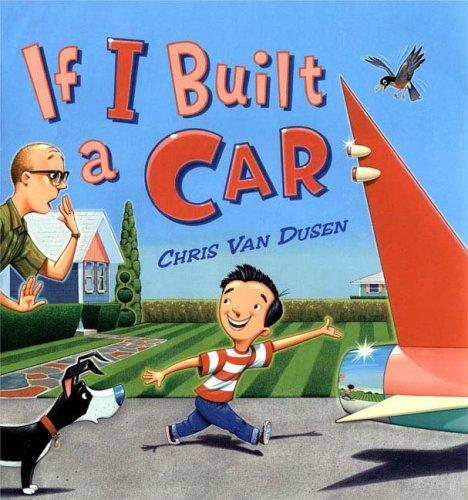
Fisher Price cars, Matchbox cars, model cars...boys love them. These speeding, crashing, even flying toys become characters, defined by a child’s ever changing imagination. Many a boy dreams of being a race car driver, a bulldozer operator or perhaps a Zamboni master. These are the boys who will love If I Built a Car.

As the book begins, Jack rides in the back seat of his father’s car. It is a vehicle that fails to impress.

This car is OK. This car is not bad.
But it’s just a car. Nothing great. Nothing grand.

Jack uses the ride to think about his designs for a truly remarkable car, a dent-proof, passenger-safe invention with a face, fins and a Plexiglas dome. Inside, this contraption offers comforts that exceed the perks of glitziest stretch limo. Who wouldn’t want to nap while Robert the Robert navigates the journey, especially when “he’s guaranteed not to hit telephones poles”? Ah, luxury without the irksome lawsuits.

There’s more to amaze the reader. Jack’s creation floats on water, dives below the surface and catapults into the sky. The feature that is my personal favorite is that noxious fumes are transformed into tantalizing smells such as just-picked roses or fresh-baked blueberry muffins. How nice of Jack to provide momentary pleasure to pedestrians who cannot have their own super-mobile!

There is much for intrigued readers to digest. Van Dusen does not water down the vocabulary as he refers to retractable wings, zeppelins, a catamaran and even a stickleback gar. On first read, the terms will be overlooked details as the illustrations serve as the focal point. However, on repeated visits, the inquisitive reader/listener will want to know more. I can see this book triggering rich discussion, online research and a search for more books about different modes of transportation.

The illustrations provide a retro-modern vibe reminiscent of the futuristic depictions on “The Jetsons.” In fact, the endnote about the author indicates that Van Dusen’s inspiration came from visions of the future portrayed in Popular Science magazine from the 1950s and 1960s. The shout-out to the past extends to the malts and aerosol cheese snacks stocked in Jack’s über awesome invention.

The best part of reading If I Built a Car is the book can be a vehicle to the planning and drawing of the reader’s own fantasy car. Perhaps the child can create a whole new transport line, with sporty compacts, state of the art ambulances and truly magical school buses. Fifteen years from now, I may still be driving the same ol’ Civic, but what fun it will be to see a fleet of innovative inventions whizzing by me on the highway!

Friday, July 8, 2011

A PET FOR PETUNIA


By Paul Schmid


(Harper, 2011)


A few years ago, kids were obsessed with penguins. Not practical as pets, but no doubt common items on Christmas wish lists.


Petunia has a different black and white critter in mind: a skunk. Schmid writes, "Petunia wants, wants, wants! a REAL pet skunk." And Petunia is a persistent child.


Parents and children will be able to relate to the pet-begging pitches and promises. If Petunia gets a skunk, it will surely be one pampered pet. But Petunia's parents hold strong, daring to assert that skunks stink.


Petunia's ensuing verbal tantrum is the highlight of the book. (Too many of us will see ourselves in petulant Petunia.) She decides to run away and you can guess what she encounters in the woods.


The simple, amusing black and white illustrations are adorned with splashes of purple and the odd dash of mustard yellow. They are just enough to move the story along. It's Schmid's word choice and phrasing that truly stand out.


While I rarely review books with female protagonists, boy readers will easily connect to Petunia and their own imaginations are likely to be sparked by thoughts of an ultra-stinky pet. Penguins? Yawn. Pigs? Phooey! The skunk's the thing.

Sunday, June 26, 2011

I MUST HAVE BOBO!


Written by Eileen Rosenthal


Illustrated by Marc Rosenthal


(Atheneum Books for Young Readers, 2011)


Linus had his blanket, but most of us clung to a stuffed animal during our younger years. Mine was a well-chewed grey dog named Woofie that disappeared for years, only to turn up at the bottom of our deep freezer in the basement. I still blame my sister.


In I Must Have Bobo!, Willy's morning gets off to a rocky start when he discovers that his beloved socky monkey has vanished. Billy is distraught. How can he cope with all the uncertainties in life without Bobo?!


The story is a delightful battle for Bobo between Willy and Earl, the family pet. Bobo's back with Willy. Bobo's gone again.


Can Willy and Earl learn to share Bobo?


The simple, colorful illustrations and short text complement each other perfectly. This book will make both children and adults smile. And maybe a few of us older readers will secretly hug a teddy bear when looking at bills online or before bedtime. At the very least, hug the family pet!

Sunday, September 19, 2010

THE INCREDIBLE BOOK EATING BOY


By Oliver Jeffers

(Harper Collins, 2006)

There's a big difference between eating green eggs and ham and eating Green Eggs and Ham. In The Incredible Book Eating Boy, Henry opts for the latter, consuming books in a manner that fills the stomach as it feeds the brain. Henry begins with a word, then a sentence and builds up to downing an entire book in one sitting. It's the express way to becoming smart. Until things backfire.

I have read this book to many classes and it is always a hit. Jeffers's straightforward text is enhanced by simple pictures superimposed on maps and what appears to be faded print from old books. The result is marvelous, a book that can be read or simply leafed through dozens of times. The book's design even includes an extra delight on the back cover: a bite missing in the bottom corner. Even before I show the title, I act aghast as I stare at the bite mark and gaze at the attentive group of listeners. Who didn't have enough for lunch?! Who has been feasting on my precious book?! It's a startling hook and the audience remains intrigued until the book is finished.

The Incredible Book Eating Boy is a delectable treat!

Sunday, August 22, 2010

WHY ANOTHER BLOG?

As I tried to name this blog, I was reminded of the Blog Clog. The logical, desirable names were all taken. (Story of my life, but that's another blog.) It came down to dlfkrtnspaoi24 or BoyzRead. While "dlfkrtnspaoi" has a nice ring to it, I was a bit put off by having to share the moniker with twenty-three others. (I draw the line at nineteen.)

This is a blog intended to promote boys' reading. There are others out there, but I hardly think the topic is overdone. Many guys out there still find reading as much fun as flossing. I should know. From sixth grade until I hit thirty, I was one of them.

Some of the items featured will be the high quality reads that everyone can identify by the embossed sticker on the cover. But only some. When I was a kid, I viewed that sticker as reading repellent in the same way a mosquito regards a tasty looking calf muscle that's been slimed by a liberal spray from the OFF! can. Ruins the feast. (As an aside, do calves have calf muscles? Since all their other muscles are calf muscles in that they are the muscles of the calf, is the anatomically correct calf muscle, then known as the calf-calf muscle? I won't even get into what happens when the calf dons a muumuu. Gary Larson, get out of my head! Excuse my while I take my Tylenol.)

I knew that award winning books made librarians all warm and fuzzy inside. But my school librarian (we had them back then) wore a butterfly brooch and walked around with her index finger glued to her lips. I couldn't see how my interests would in any way match someone who had such a need for tranquility. "If you're all really quiet, you can hear the robin singing outside," she'd say. It was December and snow was falling. That's when Mrs. Gordon lost all credibility.)

As I matured, I realized that sometimes stickers were a good thing. (Loved the scratch 'n' sniff era. Aah, root beer. Ketchup. Skunk!) But an enticing title, a cool cover design and, most of all, a thumbs-up from a best friend will get a guy to read more than any shiny (even smelly) sticker. It's the content that needs to be highlighted—quirky characters; a snort-inducing passage; a compelling plot; a fascinating info topic; an accessible, perhaps original, navigation system for nonfiction.

Boys' reading interests are broad. What I love or even what one's best friend loves might be as repugnant as The Bobbsey Twins to you or a boy you know. I'm just one guy trying to get other guys to identify their inner reader. I'll state my biases upfront. I'm not an action adventure reader. (After awhile, I just want the bad guys to kill the protagonist so we can all for a bike ride.) Wizards are fine once in a while. Dragons? Meh. Sci fi? I'd rather read about Bert and Nan, Flossie and Freddie.

Humor works for me. I prefer something slightly higher brow than farts and dog poo, but I can see how the base stuff makes some guys blow snot out their noses. A good thing as long as I am beyond projectile distance. More than anything, I enjoy books that portray guys who think and feel, rather than just act. (I think the importance of "show, don't tell" has been overstated.) I grew up with male characters that solved mysteries, trained and became the local team's sports hero or took the form of a sports car driving mouse or an ice cream loving monkey. At times, they were good reads. But I wanted to know that boys could be more than crime solvers, jocks and lovably anthropomorphic creatures.

That should give you insight as to my own bent. I will, however, stray from my comfortable path on a whim. At some point, I'll still feature that monkey and his ice cream parlor escapade, but I hope to celebrate more evolved characters and plots, too. (Perhaps a monkey that saves an ice cream business is indeed highly evolved.)

In this blog, I'll showcase books, websites and other reading sources that may be of particular interest to some boys. I'll also post entries about getting boys to read and I encourage blog visitors—and regulars (fingers crossed)—to engage in a discussion by leaving comments. Let me know if my word is gospel or if you think I should be thrown on a pyre with every Captain Underpants book ever printed.

By the way, the name of the blog didn't come just by default since all the good ones were taken. (Again, that's another blog.) I'm the kind of stickler who finds salvation (and great humor) in repeated readings of Lynne Truss's Eats, Shoots & Leaves. The slangy (sloppy?) reference to Boyz instead of Boys is not an homage to overrated boy band Boyz II Men (although they hit a homer with "Water Runs Dry"); rather, it's a reminder that, when we consider ways to get boys hooked on reading, we have to shake off standard conventions. Like it or not, people talk at regular volume in the library, comics can be way cooler than Charlotte's Web (blasphemy?) and there is a place on the shelf for a dog with flatulence.

We may disagree on the content, but let's agree to read. And to get boys—yes, and girls—reading!