Showing posts with label Mac Barnett. Show all posts

Sunday, November 24, 2024

JOHN'S TURN


By Mac Barnett


Illustrated by Kate Berube


(Candlewick Press, 2022)


I checked this book out of my local library based on the writer’s name and the cover image. Mac Barnett is a clever, sparkly writer of children’s books like Sam and Dave Dig a Hole and Count the Monkeys. I figured I could use some amusement. But this isn’t that kind of book. (More on the cover in a bit.)


The book focuses on a regular feature of a school’s Friday morning assemblies. At the end, one student performs a special talent, such as playing the tuba, performing magic tricks or doing stand-up. This Friday, as the title notes, it’s John’s turn. 


At breakfast in the school cafeteria, John doesn’t look so good. The students around him eat, chat and laugh. John does none of that. He’s got a case of the nerves. Later, backstage, he changes into a white leotard, black pants and slippers. He sits, anticipating his performance, still looking nervous as the assembly proceeds through its normal agenda items:

                            Mr. Ross reminded us permission slips

                            were due Monday. We all sang a song.


At last, it’s time for John.


                            “What’s John gonna do?”

                            Andre asked without raising his hand.

                            Mr. Ross looked at his paper.

                            “He’s doing a dance.”

                            “Cool,” Andre said.

                            He never raises his hand. 


There’s always an Andre. And the fact there is, makes the reader worry a little for John. This is unlikely to be Andre’s (and others’) version of a cool dance. 


John dances. Neither John’s movements nor the music—“strings, violins and things”—is familiar. Kids laugh.
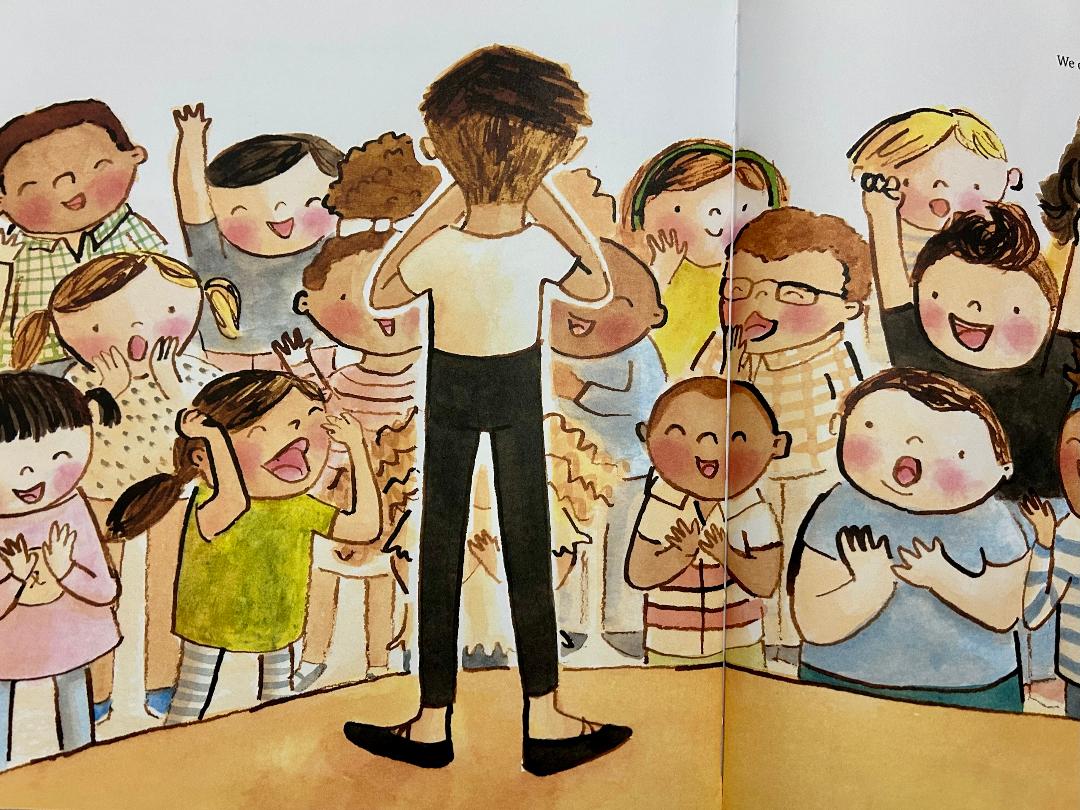


But they stop when shushed. John commits and, yes, he shines. He takes a bow. How will his peers respond? The ending, of course, is how we want things to go for every young John, daring to be different, sharing his true passion.


Bravo!   
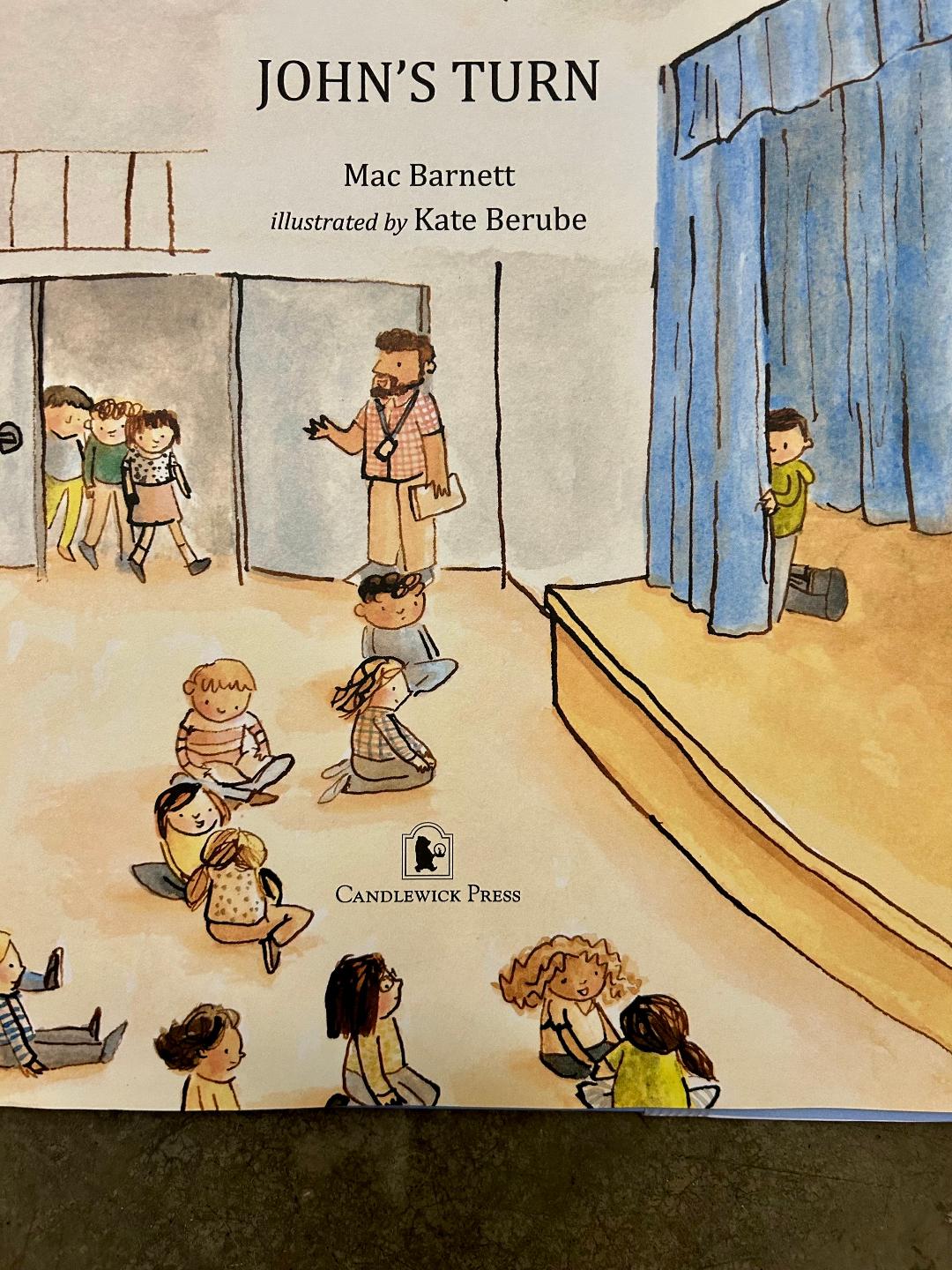


I do have a quibble over the cover. I admit the image of a young boy in ballet gear, complete with pointe shoes, drew me in. I knew this kid book would be different. I figured it would confront stereotypes and traditional gender roles. As an adult, I saw the cover’s message: Very Special Book. But, for kids, the cover may make them giggle—boys, especially—and steer clear of picking it up. I would have preferred an image of John’s face nervously peeking through a stage curtain at the expectant audience. Indeed, there’s a suggestion of this in part of the title page. Given that the book avoids mentioning John’s talent right away, the cover is also a spoiler, making the reveal less dramatic.


On my second time paging through the book, I focused on Kate Berube’s illustrations, done with ink and paint on cold-pressed watercolor paper. She skillfully depicts each scene. The title page shows students gathering in the open assembly room (aka the cafeteria), some finishing up breakfast, some chatting, some seated facing the stage, ready for what’s to come, one intently reading a book in his lap. 


Whenever Mr. Ross talks, there’s at least one audience member talking to a neighbor. By contrast, when a student performs, the students give them full attention.


And then comes John’s turn. Classical music plays and the students look bored, skeptical; one looks primed to heckle. John looks like he’d rather be anywhere else, his face full of angst. His face is tentative during his first moves.


And then… 


In a double-page spread, Berube depicts six stages of one grand leap and we see John’s face change from worried and cautious to proud and accomplished. From that point on, there is no turning back. John is in his element.  


This is a well-told story and a highly useful book to share with children before talent shows or any school assembly when students or a theater/dance group performs. It’s also a great conversation starter about following one’s interests no matter what the peanut gallery might say or do. Pot-shots are easy. Sometimes they come when someone feels uneasy, the subject matter unfamiliar. Sometimes they arise from a desire to mock. There will always be critics. 


Let John and boys like John dance on.


Wednesday, July 26, 2023

A POLAR BEAR IN THE SNOW


Written by Mac Barnett


Art by Shawn Harris


(Candlewick Press, 2020)


I’ve reviewed a couple of Mac Barnett book, Count the Monkeys and The Wolf The Duck & The Mouse [a comma-free title, presumably, in part, to avoid that whole Oxford comma divide]. Barnett’s stories are often quite humorous and, by comparison, A Polar Bear in the Snow is subdued. I would imagine Barnett was amused by white pages described as a polar bear caught in a snowstorm and decided, Well, why not go with it? There’s a story there but, truthfully, not much of one. The appeal of this book is in the art by Shawn Harris who uses rough card stock for the snowy background and then uses cut-out pieces and minimal black ink to create the arctic’s flora and fauna.


A blank white page is the start and then blank ink shows the polar bear emerging, first just his nose, then his eyes as well. As the bear begins to stir, Barnett invites the reader to wonder where he is going. Thick, torn paper in off shades of gray and white makes for a snowy terrain. There is a Jon Klassen influence in the text—indeed, the two have collaborated in the past—when Barnett asks, “Is he going to visit the seals?” We see a cluster of cutesy, frolicking seals. The answer on the next page may startle the young reader: “No. He is not hungry.” Hello, reality check.


The destination, after briefly terrorizing a human, turns out to be the sea. This provides a striking shift in color, the whites giving way to shades of blue, as the bear gets his own opportunity to frolic, the seals wisely out of sight and the fish apparently not to the polar bear’s liking at that moment. The scant story—nothing more than a jaunt—ends back on land, the familiar image of white…a polar bear caught in a snowstorm, though this time Harris has left some abstract tracks on the page. 


It's a calming book, somewhat captivating in a low wattage sort of way. Worth a browse.


Saturday, March 16, 2019

THE WOLF THE DUCK & THE MOUSE

Written by Mac Barnett

Illustrated by Jon Klassen

(Candlewick Press, 2017)

I have to prepare for the worst when I read a picture book with Jon Klassen’s name attached to it. As an animal lover, I didn’t immediately embrace I Want My Hat Back due to the ending. (I’ve come around, loosened up a tad.) Klassen and Mac Barnett are gifted humorists who, along with Mo Willems, have shaken up the picture book industry. So I opened The Duck The Wolf & The Mouse [no comma in the title] with both anticipation and trepidation. Predictably—at least for a book by these two—the book begins with a jolt:

Early one morning, a mouse met a wolf,
and he was quickly gobbled up.

In the traditional picture book world, this would not happen. Wolf and mouse would go on an adventure or exchange curiosities but there would be no eating, except maybe a pizza or some fresh-baked bread. Of course, the wolf eats the mouse. What a tasty snack.

But then things get twisted. The hungry wolf swallowed the mouse whole. And, prior to that, he swallowed a duck whole. Now mouse and duck live in perpetual darkness in the wolf’s achy belly. As duck invites mouse to join him for breakfast, mouse asks:

“Where did you get jam? And a tablecloth?”
The duck munched a crust.
“You’d be surprised what you find inside a wolf.”

Of course! It’s a winking explanation for all the nonsensical picture books with animals eating at pre-set dining tables.

The poor wolf experiences all sorts of stomach pains due to his active residents. (Is the moral of the story for little boys and girls, Chew your food? My mother would approve.) I shall not reveal more but Barnett’s clever story and Klassen’s familiar dark illustrations—all browns and grays—are a delight.

This is a satisfying tale that will turn the most frowny face upside down.

Thursday, June 12, 2014

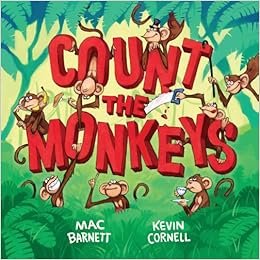
COUNT THE MONKEYS

Written by Mac Barnett

Illustrated by Kevin Cornell

(Disney Hyperion Books, 2013)

I had the pleasure of hearing Mac Barnett speak at the Society of Children’s Book Writers and Illustrators’ summer conference in L.A. last year. He had me laughing out loud as he confidently enthralled a room of wannabes (myself included). I knew this man had a refreshingly twisted view of the world. The next Mo Willems.

When I checked out a stack of Mac Barnett picture books from my local library, Count the Monkeys rose to the top of the pile. Hmm, a counting book. We all know the formula: 1 of this, 2 of that, get to 10, end of book.

I can envision Mac skimming a stack of counting books and thinking, “Yuck.” No doubt they sell, but do they have to be so boring? What could spice up this niche? How ‘bout penguins? Are they still uber popular? (What do you mean someone counted ‘em already…and went all the way up to 365? Drat.)

Forget trends. Monkeys are always good.

Mac goes for eager camp counsellor as the book opens: Hey, kids! Time to count the monkeys! It’s fun. It’s easy. All you have to do is turn the page…and COUNT THE MONKEYS. Yee-haw! I feel the energy. I’m so ready. One monkey, two monkeys, three monkeys,…

But wait. What’s this? Upon turning the page, there is not a single monkey. Instead, 1 KING COBRA has invaded the space. Mac tells us the beast “has scared off all the monkeys.” Ah, yes. There’s the twist! And Mac begins to invite audience participation. “Turn the page very slowly, very carefully,” he says, “so [the cobra] doesn’t notice us.”

There is indeed counting in this delightful book. But the constant surprise comes in what is to be counted. It’s all quirky and unpredictable. Imagine that—an unpredictable counting book. Genius!

As I read this book to a young school audience, the children fully participated in the narrator’s invitations to clap, vote, move hands in a zig-zag motion and so forth. This counting book is a pure delight, one that people of any age will enjoy as long as they still have an appreciation for random kookiness. (If you’ve lost it, please find it. Kooky is cool!) Parents won’t hesitate to read and reread this book to children. I would, however, suggest refraining from using Count the Monkeys as a bedtime read. All that zaniness is likely to get everyone involved revved up. Read it and then run outside. Swing from the trees. Just like the monkeys that may or may not appear in this book.