Showing posts with label friendship. Show all posts

Saturday, January 11, 2025

WHERE TO HIDE A STAR


By Oliver Jeffers 


(HarperCollins, 2024)


I have been a fan of Oliver Jeffers’ picture books since I discovered The Incredible Book Eating Boy which I read to countless classes and parent groups. (It’s one of the first picture books I blogged about.) That book celebrates an unorthodox love of books and a hunger for knowledge. (Yes, the title should be taken literally.) Since then, Jeffers has continued to produce whimsical, zany stories that always make me do a double take before a broad smile covers my face.


Where to Hide a Star 
is his latest amusing, satisfyingly off-kilter tale. It begins as the story of a boy and his two friends—a penguin and a star, naturally. (Yes, cue double take.) The boy and his friends love to play hide-and-seek, the boy always being It “as he was the only one who could count.” During one game, the star goes missing. Worried, the boy seeks help from a Martian (of course).


In the meantime, the star is discovered by a girl who, lo and behold, has always dreamed of befriending a star. When the boy shows up, it’s awkward. “They both wanted the star, but they didn’t want to make someone else unhappy.”


Precious. 


At this point, the story is similar to Jeffers’ This Moose Belongs to Me. But then it’s decided that the Martian will assist the star in hiding, the presumption being that whoever finds it shall claim primary friendship rights. 


I’ll leave you to discover the ending yourself.


At this point, Jeffers’ books are—to borrow a term stirred up from his Book Eating Boy days—comfort food. I always know I’m going to enjoy them. I love the familiarity of his simple illustration style with boxy bodies, stick figure appendages, and warm background colors. I know I’m going to read each book again, the first read focused on quirks, the follow-ups taking in the entire project, sometimes picking up a missed quirk. 
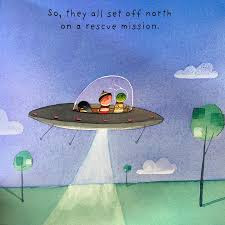


With Where to Hide a Star, Jeffers’ winning streak continues.


Friday, February 8, 2019

YOUR ALIEN RETURNS

Written by Tammi Sauer

Illustrated by Goro Fujita

(Sterling Children’s Books, 2016)

I took an extended break from this blog and some true book gems didn’t get their due via an impassioned shout-out. One such book was Your Alien, a delightful tale of friendship and goodbye when a boy befriends an alien and everything seems perfect…until the alien becomes homesick. The book was a big hit whenever I’d read it aloud. I easily created an alien voice—a cross between Marvin the Martian and Beaker from The Muppets. 


Your Alien Returns allows the opportunity to get back into alien voice for a simple one-word utterance. On this occasion, the alien comes back and the boy ventures to the alien’s terrain with the promise to be back in time for dinner.

Now it’s the boy who must adjust to new customs, new games and a whole bunch of people—er, aliens—who are foreign to him. The connections for kids will be obvious. That time they had a sleepover at Wei Lin’s house, that birthday party for Keith on their baseball team where they didn’t know anyone else, that weekend they spent with their cousins in Tallahassee (or wherever…I just love the name Tallahassee). What do you do when excitement faces a sudden jolt of anxiety?

The book isn’t quite as fun as Your Alien. The cuteness of the alien isn’t such a novelty anymore. Still, how wonderful to take familiar characters and have them deal with, well, the unfamiliar. Track down Your Alien (Sterling Children’s Books, 2015) and follow up a week later with this book. Kids will cheer to see the alien once more.


Thursday, February 7, 2013

PENGUIN AND PINECONE: A Friendship Story

By Salina Yoon

(Walker Books for Young Readers, 2012)

Haven’t we all made fast friends with someone who happens to be at the same sandbox but actually lives in a distant land (like the suburbs)?  Haven’t we all begged to have the toad or the ladybug in the backyard garden become our newest, most beloved indoor pet?  Please, mom!  But why not?!  Sometimes staying connected just isn’t practical.

This book celebrates an unusual friendship, springing from an immediate bond when Penguin discovers “a curious object” on the ice:  Pinecone.  Immediately, Pinecone becomes more than a toy; Pinecone is a friend.  Penguin knits a scarf for his new friend and wraps it around Pinecone to keep him warm.

Still, something seems to be wrong with Pinecone.  Penguin’s grandfather has to explain what is literally the cold, hard truth:  “It’s too cold here.  Pinecone belongs in the forest far, far away.  He can’t grow big and strong on the ice.”

And so Penguin sets off to take Pinecone to a better home.  The image of Penguin finally leaving the scarf-clad Pinecone will touch even the most cold-blooded being, especially since Penguin goes to the trouble of leaving a special message on the ground.

When Penguin grows up, he still wonders about his friend so he makes the long trek back to the forest.  Once again, the image is precious, as is the book’s final message.

A few times I year, I discover a picture book that I can’t stop talking about.  I share it with everyone I see.  This is one of those instant treasures.  I keep it in my knapsack and pull it out at Starbucks, before the movie starts and after we’ve given the waiter our order.  (Today, I took it out while attending a conference and insisted that complete strangers give it a read.  Since they didn’t move to another table, I assume I didn’t alarm them too much!) 

With simple text and uncluttered illustrations, Salina Yoon’s message is clearly conveyed.  I have a good sense of when people are merely indulging me and when they are truly entertained.  This book has been a big hit with everyone.  You’ll look at pine cones in an entirely different way...maybe even name one Sally or Chuck.  As for me, I just might take up knitting.
Penguin and Pinecone is a pure pleasure!

Monday, November 21, 2011

I'M NOT


“Not drawn by” Pam Smallcomb

“Not written by” Robert Weinstock

(Schwartz & Wade Books, 2011)

This book is about opposites attracting. Mars, venus. Cats, dogs. Oscar, Felix.

As delightfully drawn as the two main characters are, I cannot tell what they are—just what they’re...not. Not humans. Not talking dogs. Not sponge creatures. I call them blobbies even though I am sure they are supposed to be some sort of animal. (My best guess would be dinosaurs or an alligator and a hippo. It really doesn’t matter.) One is green, the other brown. Again, I simply refer to them as Greenie and Brownie. Greenie is actually named Evelyn. Brownie is the first-person/blobby narrator.

Evelyn is the friend most of us wanted to have when we were young(er). She’s daring, artsy, imaginative and inappropriate. Brownie claims she herself is none of that. There is a clear pattern in the text: “Evelyn is up on all the latest fashion trends. I’m not.” The illustrations provide the amusement. In this example, Evelyn dresses herself in lampshades (“Lampshades are the new black!”), bandages (“Band-aids with pearls...trust me!”) and sweatbands. By contrast, Brownie dons a paper bag.

Evelyn is indeed a handful, perhaps too much for us adults who have learned to fit in, to follow rules and expectations. In truth, it is the Evelyns, Olivias and Davids of youth that attracted me to moving down from high school to elementary. Evelyn is sparkly minded, unpredictable and eminently entertaining.

Principal Milton, a stern-faced walrus represents spirit-sucking elements of society. Seems he objects to Evelyn’s bubble gum statue of him. Robert Weinstock adds humorous touches to the principal’s office, with framed pictures of a lemon and a soon-to-erupt volcano mounted on the wall. Ah, yes. Principals represent all that is sour. They keep the peace based on a fear of a possible explosion. Thanks for that, Mr. Weinstock!
This picture book represents a perfect merger of text and illustrations, each aspect making the other stronger. I am not sure to what extent author Pam Smallcomb had input as to the comic speech bubbles and drawings, but I assume that the editor was instrumental in ensuring that the words and pictures complement one another so seamlessly. This is a team I hope continues to work together.

A highlight for me is the two-page spread of Evelyn visiting Brownie’s house. Brownie informs us that “she changes my room.” And how! Paintbrush in hand (claw?), Evelyn states, “Your ceiling will look dreamy in orange!” My favorite page features Evelyn hanging upside down from the branch of an apple tree with the text, “She’s not one single bit ordinary.” It’s what Evelyn says in the comic bubble that gets me every time: “Look...I’m an apple!”

Like Brownie, I’m not Evelyn either. But there is a little bit of that wacky daringness locked in my mind. All of us can appreciate Evelyn...at least as a creature of fiction. I’m Not is a must read...unless you’re too much of a fuddy-duddy. Thankfully, I’m not!

Monday, November 7, 2011

BIG WOLF & LITTLE WOLF


Written by Nadine Brun-Cosme

Illustrated by Olivier Tallec

(Enchanted Lion Books, 2011)

This book would make a wonderful companion piece to A Visitor for Bear, my previous post. Like Bear, Big Wolf is accustomed to a life of solitude. He lives on his own under a tree on a hilltop. Then one day he spots a dot in the distance. The dot moves closer and gets bigger. Big Wolf worries. Will the dot, which now resembles another wolf, continue all the way to Big Wolf’s spot? And will the imposter turn out to be Bigger Wolf? The answers: yes and no. Apparently because New Wolf is, in fact, Little Wolf, Big Wolf allows the foreigner to hover under the tree on the hilltop.

“They didn’t say a word to one another, but they watched each other out of the corners of their eyes. Their looks were curious—not mean or suspicious at all.”

Little Wolf does not leave. Nightfall comes and the two settle in for a chilly slumber under the tree. Big Wolf, while peeved, shares “a teeny tiny corner of his leaf blanket”, reasoning, “‘That is certainly enough for such a little wolf.’”

Little Wolf is still there come morning. Little Wolf follows Big Wolf through the established routine. But then Big Wolf goes off on his own for a walk. Upon his return, he is surprised that Little Wolf is finally gone and even more surprised about how he feels.

This is a touching book, sure to make an adult reader choke up a tad upon getting to the final page. Children will enjoy the story, but won’t be quite as emotional. I suspect sentimentality comes with more experiences...or at least that is how I explain that a predictable yet satisfying ending leaves me with a lump in my throat.
Olivier Tallec’s illustrations have an abstract quality to them. The wolves are drawn simplistically, Big Wolf’s figure often roughly sketched in with white space remaining. My favorite consecutive illustrations depict the wolves under the tree at night and then in the same tree in the morning—different vantage points, while also going from wide angle to a closer shot. As well, the later close-up image of Big Wolf searching for the absent Little Wolf masterfully conveys a strong sense of emotion.

The text and illustrations within Big Wolf & Little Wolf combine to create a memorable story.

Monday, October 3, 2011

METROPOLITAN COW


By Tim Egan

(Houghton Mifflin, 1996)

I don’t know why, but boys like cows. They find them funny. Last year, I supported a grade four writing group and one boy insisted on adding at least one cow to every story. Before long, other boys were creating cow characters. They enjoyed making others laugh from their writing and one of the easiest gags was to think of a human action and make a cow do it instead. The Far Side’s Gary Larsen would approve.

I picked up Metropolitan Cow from the local library simply because of the title and the cover image of a cow family, each member standing on two legs and dressed as cows would before heading out for a night at the symphony. I am confident the cover will catch a young reader’s attention. The story, however, has an important message, though Tim Egan provides cheeky commentary to keep the reader smiling.

Bennett Gibbons is a young cow living a life of privilege. All is well except there is no one for him to play with near his urban abode. All the other cows are significantly older and mud-sloshing pigs are…well, they’re pigs. Cows play with cows, pigs play with pigs.

Things change when a pig family becomes the new neighbors. Bennett befriends Webster the pig who is roughly the same age and has the same interests. When the two are outside, Webster suggests they jump in the mud, but Bennett echoes his parents’ long-established directive. “I can’t. I’m too dignified.” Webster asks, “What does that mean?” to which Bennett replies, “I have no idea.”

The two continue to hang out while avoiding the temptation of frolicking in the mud. One day, however, with his parents watching, Bennett can resist no more. Who wouldn’t want to play in the mud? This, of course, causes grave concern. This is why cows don’t play with pigs.

Metropolitan Cow is a story of prejudice, opinions forming from lack of contact with groups deemed different. It may be skin color, religion, family structure (think Benny Has Two Bucks) or first language. Bennett and Webster are typical youngsters. They are open to acceptance, but susceptible to following inexplicable rules that continue to keep those who are different at bay. Sometimes, as in this story, the adults need to learn from the younger generation.