Friday, February 8, 2019

YOUR ALIEN RETURNS

Written by Tammi Sauer

Illustrated by Goro Fujita

(Sterling Children’s Books, 2016)

I took an extended break from this blog and some true book gems didn’t get their due via an impassioned shout-out. One such book was Your Alien, a delightful tale of friendship and goodbye when a boy befriends an alien and everything seems perfect…until the alien becomes homesick. The book was a big hit whenever I’d read it aloud. I easily created an alien voice—a cross between Marvin the Martian and Beaker from The Muppets. 


Your Alien Returns allows the opportunity to get back into alien voice for a simple one-word utterance. On this occasion, the alien comes back and the boy ventures to the alien’s terrain with the promise to be back in time for dinner.

Now it’s the boy who must adjust to new customs, new games and a whole bunch of people—er, aliens—who are foreign to him. The connections for kids will be obvious. That time they had a sleepover at Wei Lin’s house, that birthday party for Keith on their baseball team where they didn’t know anyone else, that weekend they spent with their cousins in Tallahassee (or wherever…I just love the name Tallahassee). What do you do when excitement faces a sudden jolt of anxiety?

The book isn’t quite as fun as Your Alien. The cuteness of the alien isn’t such a novelty anymore. Still, how wonderful to take familiar characters and have them deal with, well, the unfamiliar. Track down Your Alien (Sterling Children’s Books, 2015) and follow up a week later with this book. Kids will cheer to see the alien once more.


Tuesday, February 5, 2019

WILD THINGS

PETUNIA GOES WILD
By Paul Schmid
(Harper, 2012)


WILD FEELINGS
By David Milgrim
(Henry Holt and Company, 2015)

Kids easily connect to wild animals. Running around, roaring and growling, is incredibly freeing. (Why did we ever stop?)

I’m a big fan of Paul Schmid’s Petunia. I first discovered her in the delightful A Pet for Petunia when she begged and begged her parents for a pet skunk. As a teacher and principal, I often carried the book from classroom to classroom, one of my Stack of Five. (I do a quick book talk about five picture books and then let the audience vote to determine which one I read aloud during the visit.) Sadly, the book was rarely chosen no matter how much I talked it up.

It seems Petunia is an in-between character. On the cover of each book, she wears a purple and white striped dress. Sadly, I suspect that the color and her gender caused many of the boys in class to withhold their vote. They say boys are less inclined to warm up to books with girls as the main character; I’m intent on changing that. I think many of the girls don’t vote to hear about Petunia because she’s not stereotypically girlish. She’s more Olivia (the pig) than Belle (the princess).

I often read A Pet for Petunia as a “bonus read” after the top vote getter. (“But it didn’t even come in second,” someone always says. Ah, let’s expand our horizons.)

Like it’s predecessor, Petunia Goes Wild works best as a read-aloud when you’ve read it to yourself a couple of times. You want to nail the part of Petunia. There are stereotypes to be broken, after all. Petunia has a stuffed animal that’s a lion and—no, she doesn’t want a pet lion this time around. Rather, Petunia is a lion. She roars at passersby from the front yard, she crawls and eats from the floor, she even bathes in a mud puddle. So very lion-ly.

For a parent, all this feral, feline behavior can be problematic. As in A Pet for Petunia our feisty, persistent main character eventually drives her parents to utter exasperation. There is an incredibly wordy page that is the most fun to read out loud. It’s a classic parental rant.

And, as a read-aloud, at least, kids love it. They all have parents who’ve succumbed to a rant.

Petunia is both genuinely funny and wildly imaginative.

The cover photo of David Milgrim’s Wild Feelings shows the main character—a boy this time—dressed as a lion, mouth agape in full roar. Milgrim goes through a series of familiar similes, comparing feelings to animals.

Do you ever feel...
as stubborn as a mule?

Or as chicken
as a chicken?

This is a book for kids—especially boys—to connect with a range of often negatively viewed feelings. It’s a springboard for talking about them and normalizing them.

So what’s an acceptable thing to do when you’re “rrrrrreally mad”? How do you recover when it’s all over, when perhaps things didn’t go so smoothly while you were in the midst of the mood?

Picture books like this not only entertain, but they open the door for talking about more difficult things. They can be reference points after the fact as well. (Remember that book we read about...?) If kids can name their feelings and talk about them, the “bad” feelings won’t go away but they’ll learn how to work through them (more appropriately over a period of time). They’ll also give their temperamental friends some support and/or space when they’re in such a mood.

I’m wild about both these books. Track them down and have a roaring good time sharing them with the kids closest to you.

Friday, February 1, 2019

AFTER THE FALL: How Humpty Dumpty Got Back Up Again

By Dan Santat

Roaring Brook Press (2017)


In After the Fall, Dan Santat takes classic nursery rhyme character Humpty Dumpty and imagines that all the king’s men managed to put him back together again. Give or take a few bits and pieces.
In truth, poor Humpty, who loved sitting atop walls—to be closer to the birds—is a little broken. There’s a heartbreaking image of the bandaged egg sleeping on the floor in his room. Seems he’s too scared to climb the ladder to his bunk. Moreover, he dares not reach for the upper shelves in grocery stores where the truly tasty cereals like Just Marshmallow and Sugar Elf are stocked. Sadly, that leaves him to the bland brands on the lowest shelf—cereals with names like Fiber Flakes and Grown-Up Food. (Poor Humpty, indeed!)
Santat’s lovely, whimsical illustrations are cast in darker, muted colors with a range of perspectives from over-the-shoulder shots to aerial views. Every page invites the viewer to pause and study the images.
In time, Humpty Dumpty makes do, making paper airplanes. If he can’t reach higher altitudes, at least his creations can. And then one day, dear Humpty must face his fears. Something precious forces him to consider ascending a ladder and being atop the fateful wall once more. Can he do it? And will nursery rhyme history repeat itself?
This is a wonderfully endearing tale of resilience with a surprise ending that makes the reader want to immediately reread the story now that he is in on some nuances of the story that should have been (but weren’t) obvious. By golly, Santat manages to shed light on both the classic story and his reworked sequel of sorts. The result is absolutely delightful!

Friday, November 2, 2018

BOYS WHO WEAR DRESSES


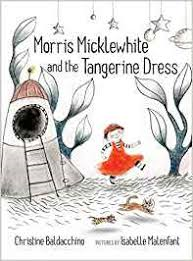
MORRIS MICKLEWHITE AND THE TANGERINE DRESS
Written and Illustrated by Christine Baldacchino

(Groundwood Books, 2014)


10,000 DRESSES
Written by Marcus Ewert
Illustrated by Rex Ray

(Seven Stories Press, 2008)


There are books that make me wish I weren’t taking a leave of absence as an elementary school principal. There are funny ones I long to read to a group of eager kindergarteners or a room of resistant grade sevens. There are captivating picture books with a-ha moments that require an immediate second read to marvel over how the author surprised the audience. And then there are the teachable books, the ones with insights that build awareness and transform the reader with new understandings. Morris Micklewhite and the Tangerine Dress and 10,000 Dresses are two books I’d like to workshop, with staff, with students, with parents. Fictional characters like Morris and Bailey can make the lives of many real people a little easier.

First up, Morris. He lives with mother Moira and his cat Moo. (Yes, the alliteration is a little heavy at the get-go.) Morris is one of those youngsters who likes many things. “Mondays are great,” we are told, “because on Mondays, Morris goes to school.” So many of the things he likes happen there. What Morris likes most is center time, when he chooses to play dress-up. That’s when he gets to wear the tangerine dress which “reminds him of tigers, the sun and his mother’s hair.” He loves the swishes and crinkles he hears while moving in the dress and the click, click, clicks from the shoes he wears with it. But, “[s]ometimes the boys make fun of Morris. Sometimes the girls do, too.” Soon Morris doesn’t want to go to school.

On the title page of 10,000 Dresses, we see Bailey, smiling and wearing a simple white t-shirt and underwear. The message: this is a boy. But the story opens, perhaps jarringly with, “Every night Bailey dreamed about dresses.” There’s some awkward language about a stairway in a “red Valentine castle” that had me frowning, but this is more of a message book than a literary marvel. Bailey’s dreams involve dresses of rainbow-flashing crystals and lilies, roses and honeysuckles. Her dreams are instantly dashed by her parents. (Yes, this 2008 book uses preferred pronouns of she and her for Bailey.) “You’re a boy,” his mom says. “Boys don’t wear dresses!”

And Bailey’s response is heartbreaking: “But...I don’t feel like a boy.”

There have always been Morrises and Baileys. But, in my day, they would have to change. They would have to don and dream of dresses in secret. Either that or the bullying would be relentless, stretching from kindergarten to the great beyond. Morris would be mocked as “Margaret.” “Melissa.” Or the much-maligned, all-purpose sissy taunt: “Nancy.” But we’re in a time now when most would recognize that it’s everyone else that needs to adjust. Morris is just being Morris. Bailey can be whoever she wants. Why should anyone have a problem with that?

Sadly, they still do. As early as kindergarten, boys know to avoid pinks and purples and to leave the dolls alone in the play centers...unless they are being used to fire out of a make-believe cannon. Gender roles are established, whether it’s due to nature, nurture or a combination.

A colleague of mine shared how she refused to buy toy guns or other weaponry for her two boys and yet, even before they learned to wave, they were using their thumb and index finger to form a quick-draw gun. Bang! Bang! As I shopped for my cousin’s baby shower this summer, I was dismayed that so much, from cards to gift bags to stuffed animals, came in pink or blue. Baby Jack’s nursery is painted green and adorned with gray whales, crabs and octopuses. (Side note: turns out octopi is an “improper plural”.) I am further reminded of a fascinating New York Times article about trying to reverse gender roles and also teach gender neutrality: “In Sweden’s Preschools, Boy Learn to Dance and Girls Learn to Yell”.

Some may indeed be entrenched in their typical male or female gender identification. The point is to open their eyes to the fact it’s okay for others to express themselves differently and to open the door for others to explore a more fluid or less typical gender identity.

These are important books to read and discuss with children, perhaps more than once over a period of years. Despite greater awareness of Morris and Bailey, gender-role and gender-identity defying boys remain a minority. It is easy for peers to find their behaviors and preferences queer, in the “odd” sense of the word. If a child’s first reaction—i.e., a boy wearing a dress is odd—is not elicited and accepted, then the opportunity for transformational learning decreases. A child may listen to the story and go away unchanged, still reacting critically when he or she observes another child acting outside of gender norms. Ridicule may go underground. Then it’s a burden for the targeted child to have to muster the courage to report or to have bear in on his own. Books like these seek to increase awareness and acceptance to reduce burdens. They also provide safe reference points for parents, teachers and children. “Remember when we read that book about Morris and the orange dress...?”

Both books are worth reading, perhaps a week or a month apart. (Pull out the first book to read another time after the later reading of the second book.) It helps kids to know that Morris Micklewhite and the Tangerine Dress (or 10,000 Dresses) isn’t some one-off book. There are positive traits about both characters that should be elicited from the reading audience. The boys-wearing-dresses images may be vivid takeaways but there is more to admire about Morris and Bailey.


Friday, June 13, 2014

BAD DAD


Written by Derek Munson

Illustrated by Melody Wang

(Cannonball Books, 2013)

Parenting can be challenging, especially when a mother has to do it all by herself. Bad Dad is not an ode to the single mother; rather, it is a recognition of the fact that some fathers require as much supervision as the children. Some people take “kid at heart” too far.

Dad is the one who breaks the bed. Shouldn’t have turned it into a makeshift trampoline. At the very least, he should have just watched.  (But don’t we all yearn for bed-bouncing days of yore?)

Dad creates havoc in the kitchen, at the toy store and throughout the neighborhood. Cue title: Bad Dad!

Everyone is in agreement. Perhaps dad should move into the doghouse. Permanently.

Thankfully, he has endearing qualities, too. He’s a homework helper and a hamster provider. Even better, “He banished Brussels sprouts from our house forever.”

Maybe that makes up for an infraction or two.

This is a timely read for Father’s Day, a reminder that no father—no parent (or child)—needs to achieve perfection. Being present can be the greatest present of all. One can pay off the new bed frame in a few months, but those memories of full-on engagement last forever.

Thursday, June 12, 2014

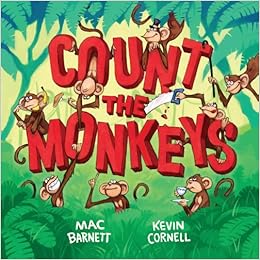
COUNT THE MONKEYS

Written by Mac Barnett

Illustrated by Kevin Cornell

(Disney Hyperion Books, 2013)

I had the pleasure of hearing Mac Barnett speak at the Society of Children’s Book Writers and Illustrators’ summer conference in L.A. last year. He had me laughing out loud as he confidently enthralled a room of wannabes (myself included). I knew this man had a refreshingly twisted view of the world. The next Mo Willems.

When I checked out a stack of Mac Barnett picture books from my local library, Count the Monkeys rose to the top of the pile. Hmm, a counting book. We all know the formula: 1 of this, 2 of that, get to 10, end of book.

I can envision Mac skimming a stack of counting books and thinking, “Yuck.” No doubt they sell, but do they have to be so boring? What could spice up this niche? How ‘bout penguins? Are they still uber popular? (What do you mean someone counted ‘em already…and went all the way up to 365? Drat.)

Forget trends. Monkeys are always good.

Mac goes for eager camp counsellor as the book opens: Hey, kids! Time to count the monkeys! It’s fun. It’s easy. All you have to do is turn the page…and COUNT THE MONKEYS. Yee-haw! I feel the energy. I’m so ready. One monkey, two monkeys, three monkeys,…

But wait. What’s this? Upon turning the page, there is not a single monkey. Instead, 1 KING COBRA has invaded the space. Mac tells us the beast “has scared off all the monkeys.” Ah, yes. There’s the twist! And Mac begins to invite audience participation. “Turn the page very slowly, very carefully,” he says, “so [the cobra] doesn’t notice us.”

There is indeed counting in this delightful book. But the constant surprise comes in what is to be counted. It’s all quirky and unpredictable. Imagine that—an unpredictable counting book. Genius!

As I read this book to a young school audience, the children fully participated in the narrator’s invitations to clap, vote, move hands in a zig-zag motion and so forth. This counting book is a pure delight, one that people of any age will enjoy as long as they still have an appreciation for random kookiness. (If you’ve lost it, please find it. Kooky is cool!) Parents won’t hesitate to read and reread this book to children. I would, however, suggest refraining from using Count the Monkeys as a bedtime read. All that zaniness is likely to get everyone involved revved up. Read it and then run outside. Swing from the trees. Just like the monkeys that may or may not appear in this book.

Tuesday, June 3, 2014

PICTURE BOOK PICKS FOR STUDENTS GOING INTO KINDERGARTEN


BIG BEAR HUG
By Nicholas Oldland
(Kids Can Press, 2009)
     I’m not sure I would really want a bear hug. But this is the story of one bear with an irrepressible urge to offer hugs. The illustrations are priceless as a bug-eyed rabbit, a moose and a skunk encounter the loving bear.  The story becomes more amusing when Oldland informs us that “what this bear loved to hug most were the trees.” 
     The tale takes another turn when the bear comes across a lumberjack, intent on chopping down the biggest tree in the forest.  Grr! What will be the bear’s natural reaction?

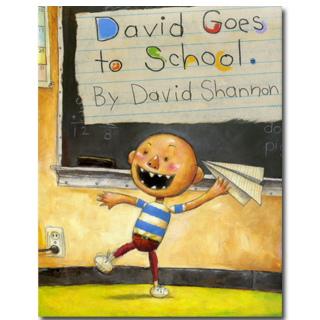
DAVID GOES TO SCHOOL
By David Shannon
(Blue Sky Press, 1999)
     Thoughts of a new school year can make everyone nervous—students, parents, teachers, even principals. There are high hopes. Yet sometimes hopes are dashed as soon as the rules are stated.
     As a teacher and principal, I see David every day. There's one in every class, usually more. He's impulsive, excitable, a dreamer. Full of energy, he seems to be recognized more for his infractions than his contributions. David is the type of student who requires us to look at the classroom from a different vantage point. David is looking for fun and, sadly, school can seem like anything but. David's need to express himself must be channeled in a positive way so as not to squelch his eager mind.

GOODNIGHT, GOODNIGHT, CONSTRUCTION SITE
Written by Sherri Duskey Rinker
Illustrated by Tom Lichtenheld
(Chronicle Books, 2011)
     This is a bedtime story for little ones who pass the day digging and building in sandboxes with tough trucks that create, demolish and rebound all to a soundtrack of animated whirrs and booms.

There is a time when construction workers, both young and old, must call it a day and when even the powerful vehicles must shut down for the night.
     No doubt, this will be a popular read night after night. I can envision parent and child whispering goodnight to each truck before the parent provides the final tucks and bids the child, “Shh...goodnight, _____, goodnight.” And,...lights out.


NOT A BOX
By Antoinette Portis
(HarperCollins Children's Books, 2007)
     I love toys. When children walk into my principal's office, they notice two things: (1) kids' books, and (2) toys. With the right imagination, most anything can be a toy. The cardboard box is a true classic, right up there with yo-yos, red wagons and Legos.
     This picture book is an ode to the lowly cardboard box, cleverly designed to resemble one. Inside, the unimaginative narrator—an adult?—remains mystified as to why the young bunny is on, in or near the box. The narrator’s questions and point of view are represented on black and white pages. In between, we see the imaginative play of the bunny, shown in bright colours. Play on, bunny!

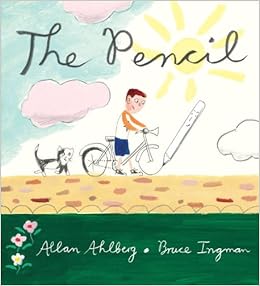
THE PENCIL
Written by Allan Ahlberg
Illustrated by Bruce Ingman
(Candlewick Press, 2008)
     A pencil rests on a blank page before discovering its ability to draw. Pencil draws a boy, but then the boy has a request: a dog. Dog wants a cat. Naturally, a chase ensues. The story goes on and on, with problem after problem popping up. (Just wait until pencil draws an eraser!) Oh, such goofy fun!


PETE THE CAT: I LOVE MY WHITE SHOES
Written by Eric Litwin
Illustrated by James Dean
(Harper, 2008)
     Pete the Cat loves his brand new white shoes, adorning each of his paws. For most cats, wearing shoes would not be a happy predicament, but Pete so loves his white shoes that he sings a ditty about them.

     For a roaming kitty, white doesn’t stay white for long. The shoes change color as Pete meanders through such things as a pile of strawberries. The whiteness is gone! Pete may not have expected this, but rather than whine, cry or meow mournfully, Pete simply changes his tune a tad and goes with it. The message is clear: have fun and be resilient.
     (As a bonus, you can find a live telling of the story on YouTube. It will help you get the tune down and maybe start you on the road to superstardom.)

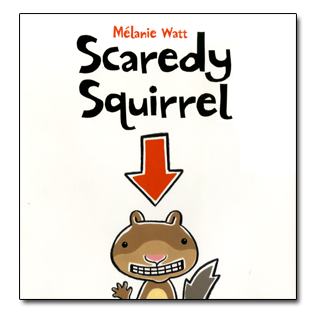
SCAREDY SQUIRREL
By Mélanie Watt
(Kids Can Press, 2006)
     We get a sense of the main character immediately upon opening the book. There, amid a pattern of acorns, is a sticker: “WARNING! Scaredy Squirrel insists that everyone wash their hands with antibacterial soap before reading this book.”
     Scaredy Squirrel fears the unknown so he spends all his time in the same tree, following the same ho-hum routine every day. He has real fears of tarantulas, poison ivy, green Martians, killer bees, germs and sharks. These things lurk just beyond the tree, right?
     Because the fears are so great and so imminent, Scaredy creates an emergency kit and several exit plans if, and only if, escape is absolutely necessary. Naturally, the day comes when kit and plans must be put into action. And, of course, nothing goes as planned.


SHARK VS. TRAIN
Written by Chris Barton
Illustrated by Tom Lichtenheld
(Little, Brown and Company, 2010)
     Under what circumstances would a shark compete against a train? You only have to spend an hour with a couple of boys and a box full of toys to see the possibilities. Indeed, that is where the standoff begins in this book.
     I love this clever, absurd book. It celebrates boys’ imaginations and the shenanigans that can only come from free, unstructured play. Shark and train compete in a variety of situations.


SPLAT THE CAT
By Rob Scotton
(HarperCollins, 2008)
     Why is Splat so anxious that he needs to hide in bed? It is the morning of his first day at Cat School. Yes, this is a wonderful book to share with young readers worried about the start of kindergarten, a new school or simply a new school year. For many students (and adults, both parents and teachers), there is excitement about school but there are also the nagging What Ifs.
     Splat’s Mom must get him out of bed and off to school, no easy feat since the young feline puts up a strong resistance. When he grabs his lunchbox, Splat sneaks Seymour, his pet mouse, inside. Best not to face the first day alone. Just imagine what will happen when Splat’s cat-mates discover the pet mouse! Author/Illustrator memorably chronicle’s the first day of school.

YUCK, A LOVE STORY
Written by Don Gillmor
Illustrated by Marie-Louise Gay
(Stoddart Kids, 2000)
     The first two sentences of Gillmor’s text are perfect: “Austin Grouper had a brown dog named Fresco, a best friend named Sternberg, and a red bicycle. His life was full.” But the story does go on. Lo and behold, Austin’s world is rocked when a family with a girl his age moves in next door. Amy.
     Of course, Austin’s mom does the mother thing, insisting he go over to greet the new neighbour. He forgoes hello and immediately dazzles with his dinosaur knowledge. She is not impressed. As a result, neither is he.
     The title captures Austin’s simultaneous feelings of repulsion and attraction to the new neighbor. Why is she so...different? The author adds whimsical details, worthy of smiles if not chuckles. On repeated reads, children will focus more on different parts of the story. The details will pop.