Friday, August 3, 2012

TOTALLY JOE


By James Howe

(Atheneum, 2005)

I have posted many reviews trumpeting books for the typical boy.  Books about trucks and demolition and how baseballs are made.  But not every boy is “typical” and not everyone is okay with that.  I was reminded of this when I logged into Facebook today.  Some of my friends mentioned the long lines they endured in supporting Chick-fil-A; others continued to speak against the corporation, posting such links as a pro-gay Muppet poster.  It got me thinking about the boys who know they are gay or who are questioning their sexuality while having to endure a chicken dinner out with family.  That has got to hurt.

Totally Joe is a middle grade novel that chronicles the seventh grade year of Joe, aka JoDan, Bunch.  At such a young age, many do not have a sense of their sexual orientation, but things are very clear to Joe.  He is gay.  There must be a gay spectrum and Joe is certainly at the far end of it.  There is no opportunity to live part of his life in the closet.  He’s the stereotypical version of gay—like Jack on “Will and Grace” or Kurt on “Glee”.  Joe wore a dress at four, played with a posse of Barbies and never understood spitting/farting/videogame-and-car loving boys.  The key difference between Joe and gay TV characters, of course, is Joe is only twelve.  While questioning boys can look to television portrayals and console themselves that It Gets Better sometime later in life, Joe Bunch is living what they are right now.

Yes, Joe faces relentless bullying from classmate Kevin Hennessey and sidekick Jimmy Lemon.  But he also has a strong circle of friends, The Gang of Five (which intentionally only has four members—it’s a math joke they have).  His friends accept him as he is.  Joe is just Joe.  As the title of the book indicates, he is Totally Joe.

This character is also fortunate to have Aunt Pam who fully accepts him and buys presents like buttons with messages that say CELEBRATE DIVERSITY and BEING WHO YOU ARE ISN’T A CHOICE.  Before his thirteenth birthday, Joe has come out to his family and hung out with his first boy crush, a popular, conflicted guy who finds Joe’s “out”-ness a little too out there.

Joe’s personality is irrepressible and readers will be amused by his take on the world.  Take, for instance, this stream-of-consciousness ramble:   

The worst is on Thanksgiving, when we have all these relatives over and the guy-guys are down in the basement watching the Super Bowl or whatever it is that’s on TV on Thanksgiving (and what a football game has to do with Pilgrims and Native Americans is beyond me) (unless maybe at the first Thanksgiving the turkey got overcooked and the Pilgrims tossed it to the Native Americans and that’s how football was invented)(just a guess), and I’m in the kitchen with my mom and Aunt Pam and all the other female members of the family, and I keep thinking I should be down in the basement watching the game, but I don’t want to because I would shrivel up and die from boredom, and, anyway, I don’t speak the language.  I do, however, speak “kitchen” fluently.

Ah, Joe.  James Howe has certainly created a memorable character.

The story is told in the form of an A-Z journal—an “alphabiography”—that Joe’s teacher makes the students keep during the school year.  Mr. Daly also requires that each entry end with a lesson.  These range from “Just be who you are, okay?” in “B is for Boy” to “Popularity is a win-win for the popular kids and a lose-lose for everybody else” in “P is for Popular (Not).”

Be aware that this title pops up when I did a Google search of its title and “banned books”.  Nonetheless, this is a book that adults who work with middle school kids should read.  Moreover, it would generate lively discussion as a read-aloud or a literature circle choice.  At the very least, it should be an individual reading option in middle school classrooms and libraries.  If the school libraries won’t take a chance, then I sure hope public libraries keep it in stock.  There are guys who are not guy-guys who will be totally comforted and relieved to read that not-so-average Joes exist.

Thursday, August 2, 2012

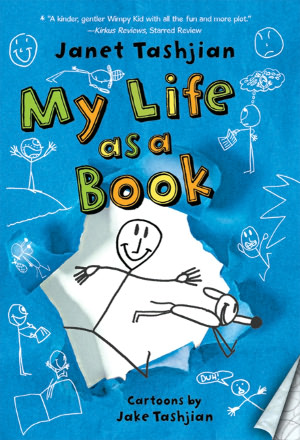
MY LIFE AS A BOOK

Written by Janet Tashjian

Cartoons by Jake Tashjian

(Henry Holt and Company, 2010)

The cover of this middle grade novel immediately conjured up Diary of a Wimpy Kid and that is exactly what the publisher is striving for, as the back cover includes a quote favorably comparing the two.  Just like many hoping to expand boys’ reading repertoires, I bought a copy but let it sit in a drawer for over a year, feeling stupid for falling for the gimmick.

Summer is a great time, however, for frivolous reading.  Turns out that My Life as a Book is better than I’d expected.  Author Janet Tashjian and I have the same agenda.  She too wants to motivate boys to take up reading in the middle years and sheds light on the issue through main character Derek Fallon, a struggling reader who doesn’t want to read.  (How many of us leap into doing things that are a clear struggle?  I have yet to hook up the cords from my new cable box to the TV downstairs.)

The story opens with Derek looking forward to summer, a time for being a nuisance at the local mall, having “grenade” fights with ripened avocadoes and staring up at clouds with his dog Bodi by his side.  But reading threatens to ruin everything. 

The first sentence of the book sets the tone:  “I DON’T WANT TO READ THIS BOOK!”  It is Derek’s reaction to a library find his mother imposes on him.  I wonder how many boys will respond to this book with the same sentiment.  (Imagine the mind trip.  Hey!  The author just read my mind!)  Derek’s desperate mother tries to bribe him with a chocolate chip for each page read and quickly doubles her offer.  As if reluctant readers can be trained like seals.  Derek temporarily escapes the reading push by climbing onto the roof and seeking refuge in the attic. 

The freedom of summer is further mucked up by his teacher.  She doesn’t just dismiss the class with “Have a good summer.  Wear sunscreen!”  No, she hands each student a required reading list.  Three books!  With reports!!  As anyone who is “reluctant” about something, Derek keeps putting off the reading.  This leaves the assignment hanging over his head for his entire vacation.

Fortunately, there are plenty of distractions.  Most intriguing comes from Derek’s attic retreat.  Tashjian is quick to stir the plot.  On page 3, Derek discovers a ten-year-old newspaper article:  “LOCAL GIRL FOUND DEAD ON BEACH.”  The Fallons live in L.A. and the article is from a Martha’s Vineyard paper.  Intrigue!  His mother’s attempts to dismiss the article only make Derek more determined to dig deeper.  Turns out his family is indeed personally connected to the story.

The story is an easy read.  The margins include quick sketches drawn by the author’s son, Jake.  They are intended to emulate the reading strategy Derek’s reading tutor imposes—creating drawings for new vocabulary to strengthen comprehension.  Perhaps it’s because I am an adult, but I found the drawings distracting.  The illustrated words are often not particularly complicated (e.g., mustache, flattened).  I get the feeling some of the words are featured just because the page needs a drawing.  Indeed some of the illustrations don’t prove helpful; rather, they may only add confusion.

Older readers (i.e., adults) may not like Derek’s character as he comes off a bit snarky, but I think the target audience will relate.  My problem is the boy’s age.  He acts far too young to be twelve, even with impulse control issues.  All through the book, I pictured Derek as a fourth grader.

Many parents will relate to the desperate negotiating tactics Mrs. Fallon tries in order to entice her son to read.  At one point, she even attempts to create excitement by putting a required reading book in an empty pizza box.  That’s bound to backfire and create some serious pepperoni madness.  But there are some practical nuggets for struggling readers, too.  In addition to the vocab draw strategy, one of the Learning Camp leaders—yes, summer fun is further squelched—teaches Derek to visualize while reading.  “Just picture every paragraph like a scene in a movie.  Close your eyes and see the character act out the story in your mind.”  Good advice.  Sadly, this doesn’t come naturally to all readers.  Imagine then what happens to reading when the more mature books reduce or do away with illustrations.

This book is intended for both young and old(er) readers.  The young will enjoy the plot and muse over Derek’s impulsive ideas.  Teachers, librarians and parents may see themselves in the novel and gain insights into what to do and what not to do in trying to creating a reading spark among some of the most resistant. 

My Life as a Book should have a long shelf life.

Wednesday, July 25, 2012

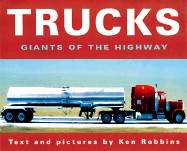
TRUCKS: GIANTS OF THE HIGHWAY

Written and photographed by Ken Robbins

(Atheneum Books for Young Readers, 1999)

As an adult driver, trucks can be a menace.  Big clunkers to pass, obstacles to the view, even if the view is only a series of billboards telling you how far it is to the alien museum and the next McDonald’s. 

But, to kids, trucks are glorious road monsters.  What youngster hasn’t delighted over getting a truck driver to honk its horn?  The quick blasts are a welcome diversion from thoughts of “How much longer?”

Trucks:  Giants of the Highway presents a photographic essay of life on the road.  Robbins adds a little text to explain parts of the big rigs.  (I’m embarrassed to say I’d never done the math regarding eighteen wheelers.  Never cared to.)  Most of the writing is clear and simple, perfect for young children.  The best writing, however, comes on the first page as Robbins refers to the trucks “loaded up with who knows what…, rumbl(ing) past like thunder on the road.” 

My extremely worn, almost tattered, library copy of the book is a testament to the appeal of the topic.  Boys will, no doubt, stare open-mouthed at the photos of the tractor-trailers and the glimpse we get of life in the cab. 

If anything, I wanted more.  How about a shot showing a boxcar being loaded with some unique cargo?  What about another page or two of the transient community that thrives on all that truck stops have to offer?  There is room for more as Robbins fills many pages with photos and no text.

I am quibbling, of course.  Kids will be enthralled, imagining their lives as a trucker.  The job has a spot in kids’ dreams, right alongside professional football player and president.  No need to make any rash decisions.  It’s a long road to adulthood.

Tuesday, July 24, 2012

HOOPS


Written by Robert Burleigh

Illustrated by Stephen T. Johnson

(Silver Whistle--Harcourt Brace & Company, 1997)

I am a vegetarian now, but when I was seven, vegetables were tolerated at best.  In the case of peas, they were wholly rejected.  I’d spread them all over my plate, trying to make it look like I’d consumed some of the original pea pile and then I’d profess to being full, willing to do without chocolate cake and ice cream just to be excused from the table to avoid another forkful of the unsavory green pellets.

Nowadays kids’ sports books are the equivalent to a pile of green peas.  I dread them.  It is a true challenge for a writer to take a high-action activity like a game of football and make it (nearly) as exciting on the page.  I cringe over bottom-of-the-ninth, bases loaded, two-out stories.  Can’t someone capture the essence of a regular day on the rink/field/court and make it memorable?
I’d say the picture book Hoops comes very close.  Robert Burleigh’s text is sparse.  It’s a game of pickup basketball, after all.  Enough talk; just play!  The first page is as follows:
Hoops.

The game.
Feel it.

And that is Burleigh’s intention for the entire book. 

On one page, he writes:

Feel the asphalt burning beneath your shoes.
The two-of-you rhythm.
The know-where-everyone-is without having to look.
So succinct and yet so vivid!
Stephen T. Johnson’s pastel illustrations are potent bursts of color, capturing a diverse group of young players caught up in the action of the game.  Any one of his illustrations would make a perfect poster to hang on the door of a boy who dreams of his future in the NBA.
I have come across many picture books transferred to YouTube videos but, alas, there is no such depiction for Hoops.  This exquisitely illustrated ode to pickup basketball deserves a new generation of viewers.  Rather than making a sport seem boring or turning it into a too technical manual, Hoops glorifies the variety of movement in the game and makes the reader yearn to get back out on the court.

Friday, July 20, 2012

IT'S NOT FAIR!


Written by Amy Krouse Rosenthal

Illustrated by Tom Lichtenheld

(HarperCollins, 2008)

I’m not sure children are the primary target of this picture book.  The inside cover is a faux legal complaint, filed in the Circuit Court of Fairness, alleging a “totally unfair cause of action” against Sibling No. 2 by Sibling No. 1.  The specifics?  A shared chocolate chip cookie halved by the defendant in a manner that showed a complete disregard for any common representation of one-half with the CLEARLY larger “half” consumed by defendant to the nutritional detriment of plaintiff.  

As a former lawyer, I loved this opening.  Children will pass it by and immediately yank another bedtime book off the shelf if a parent even attempts to read this humorous document aloud.

Further, what kid wants his oh-so-serious protestations of unfairness mocked with increasingly silly “Unfair!” whines in a work created by adults, the very sort of people who always—ALWAYS!—dismiss the aforementioned protestations?  Why would a reputable publisher like HarperCollins even publish such drivel?!  Let a child author chronicle common examples of unfairness without the smirky bias of older folks, beaten down by repeated “Too bad” dismissals of even older folks.

But, seriously, I do hope parents and teachers pick up a copy of this book,...maybe even forcing kids to pay attention, even as “unfair” allegations are made when the TV cord is unceremoniously unplugged.  Yes, it starts with a cookie, an aggrieved boy eyeing his teensy portion and saying, “Why’d I get the smaller half?”  We’ve all been there, haven’t we?  (I am compelled to add that life would be so much better if pizza makers learned how to cut equal slices!)

Each page depicts another example of unfairness, the episodes grouped in sets of two or three rhymed wrongs, followed by the oh-so-familiar “It’s not fair.”  To help you get the gist, here are the opening lines:

Why’d I get the smaller half?
Why’d he get the bigger laugh?
Why can’t I have a pet giraffe?
It’s not fair.

Save for the giraffe, the early examples are true to life, with complaints about going to bed too early, being on a losing team and getting sick on one’s birthday.  Everyone join in now:  It’s not fair!

But Amy Krouse Rosenthal helps the reader change from frowns to smiles as her examples become more ridiculous.  Why, yes, the concept of unfairness begins in the maternity ward as infants compare baby blankets.  Three-legged stools look enviously at four-legged chairs.  Even ring-less planets grouse about Saturn’s gift.   By the book’s end, there may be no resolution to the totally unfair cause of action, but it won’t matter.  Sometimes we can’t control everything.  Sometimes unfairness happens.  And, yes, sometimes the best approach is to laugh and move on. 

Tuesday, July 17, 2012

DEMOLITION

Written By Sally Sutton

Illustrated by Brian Lovelock

(Candlewick Press, 2012)

Everyone knows you’re not supposed to judge a book by its cover.  But, let’s face it, everyone does.  Publishers devote gobs of time, fretting over the design and the graphics that potential readers will see if the book is fortunate enough to have more than its spine displayed on shelves. 

The cover for Demolition succeeds in grabbing one’s attention.  A bright red and white candy-cane strip edges the top of the front and back cover and the title stretches tall in white block letters across a deep blue background.  But the illustration of a bright yellow excavator bashing against fallen concrete slabs is the clincher.  For a young boy, the message is, READ ME!

I think the copy I picked up at my local library may be a print error as the pages inside are upside down and the story begins inside the back cover.  If it is, in fact, intentional, this topsy-turvy effect of demolition is entirely unnecessary. 

Enough about covers and possible design defects.  On with the story!  There are things to destroy!  This is a rhyming picture book, one verse per double-page spread.  Each follows a formula, with a repeated statement on the first line and a trio of onomatopoeic zingers appearing on the fourth.  The opening verse provides a sample:

Grab your gear.  Grab your gear.
Buckle, tie, and strap.
Safety jackets, boots, and hats.
Zip!  STAMP!  SNAP!

It’s catchy until it feels monotonous.  I’m guessing five-year-old boys won’t mind though.  The real attraction is seeing a building come tumbling down.  The writer and illustrator do an admirable job, chronicling the destruction of a building and the transformation of its parts into a children’s playground on the same site.  The machinery (defined in the back of the book) is well drawn and will hold children’s focus.  On many pages, however, the images of workers appear simplistic, closer resembling Fisher Price figures than real people.  Intentional?  Perhaps, but I’d prefer more realism.  In fact, actual photographs might have been a bigger draw.

Of course, I am not the primary audience for this book.  There are many adults and children who pause to peek in holes kindly cut into large boards of plywood that otherwise keep us at bay at city construction projects.  Demolition will surely be a favorite among many children and I can imagine many parents won’t mind performing repeat reads.  It will allow them to polish there booming depictions of lines like, “Bang!  CLANG!  CLACK!”  This is not the soothing choice for a bedtime story, but it can serve as a warm-up to a busy afternoon with toy tractors conquering large heaps in the local sandbox.

Friday, July 13, 2012

THE CHICKEN THIEF


By Béatrice Rodriguez

(Enchanted Lion Books, 2010)

First, a quirky aside.  This book was originally released by a French publisher in 2005.  As it’s a wordless book (save for the title, an easily translatable Le voleur de poule), it amuses me that this is now an “American Edition.”  At any rate, I am so glad this tale made it across the Atlantic.

The story begins with an enchanted little cottage in a wooded area.  Rabbit greets the day by opening the shutters, Bear steps out for a yawn and Rooster prides himself on a fine “cock-a-doodle-doo”.  Yes, it’s a day like any other. 

But, if you look closely, something evil lurks, a fox in the bushes.  In a flash, he nabs a startled chicken and dashes off.  Yummy porridge must wait.  Rabbit, Bear and Rooster are in hot pursuit.

As darkness falls, the would-be rescuers are exhausted and distraught.  Fox sleeps in a tree, cradling the confiscated chicken in his paws. 

What’s that you say?  Foxes don’t climb trees?!  Just go with it.

Come morning, the chase resumes.  And the story becomes sillier as we see Fox and Chicken playing chess in an underground labyrinth.  The double-page spread at nightfall is precious, with Fox and Chicken resting in the glow of a fire in the foxhole while the other animals keep vigil by a campfire above.

And, like the Roadrunner-Coyote cartoons, daylight restarts the search.  The hunt eventually leads to a surprise ending, at least to Rabbit, Bear and Rooster.  This madcap delight serves as a reminder that things aren’t always what they seem.  In fairy tales, the fox, like the wolf, has been much maligned.  Unfairly so, according to the talented Madame Rodriguez.

Do whatever you have to in order to snatch a copy of The Chicken Thief.  You’ll “read” this wordless wonder over and over, smiling every time.