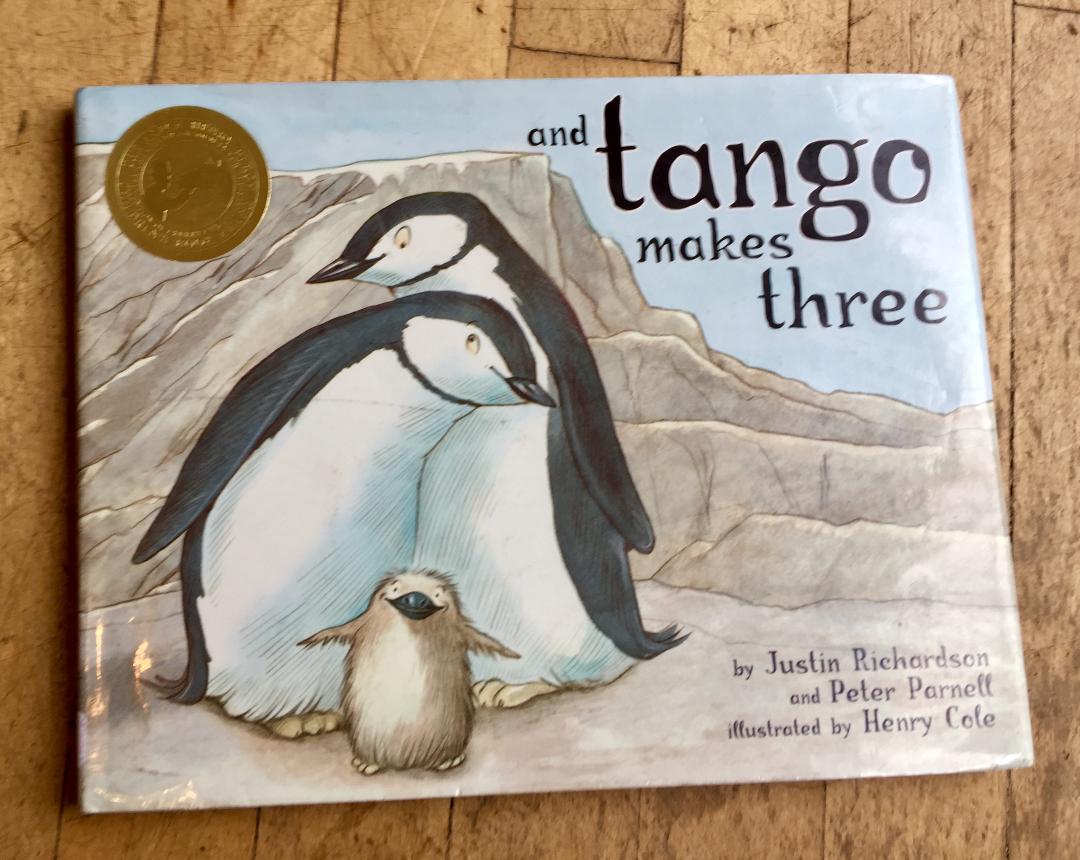
Written by Justin Richardson and Peter Parnell
Illustrated by Henry Cole
(Simon & Schuster Books for Young Readers, 2005)
Almost two decades ago, penguins were having a moment. “Trending,” we would say today. In 2005, the $8-million documentary, “March of the Penguins” grossed $127 million at the box office. “Happy Feet,” an animated feature, followed in 2006, with a risky budget of $100 million. Happy ending: it took in $384 million.
Preceding these was a 2004 article in The New York Times, “Love That Dare Not Speak Its Name,” featuring Roy and Silo, two chinstrap penguins in the Central Park Zoo, described as “completely devoted to each other.” The article noted that Roy and Silo were not a zoo penguin anomaly. “Before them, the Central Park Zoo had Georgey and Mickey, two female Gentoo penguins who tried to incubate eggs together. And Wendell and Cass, a devoted male African penguin pair, live at the New York Aquarium in Coney Island.” There were more scientific revelations, including reference to a book that noted homosexual behaviour in 450 species.
Interesting. But let’s get back to penguins and that Central Park pair, Roy and Silo. In 2005, they starred in the nonfiction picture book, And Tango Makes Three. Book shelf lives are short and this penguin title would have gone the way of the dodo by now but for book bannings and missions to remove certain content from elementary school libraries. On the positive side, it also gets a mention every June during Pride month when publications put out lists of gay books. I finally decided to browse the book myself.
 |
Opus adorned in a fruity hat...is this problematic? |
My first impression was neither a sense of shock nor pride at the suggestion of gay penguins. (Note: “gay” is never used in the book.) Instead, I was aghast that Roy and Silo would be held up as gay icons of the animal world. I am no penguin aficionado—in fact, I’ve never seen either of the box office hit movies I mentioned in the first paragraph. Perhaps penguins are true “bird brains” in the sense they’re not all that bright. My favorite penguin is Opus, a clever, amusing comic strip creation of Pulitzer Prize-winner Berkeley Breathed, appearing in the classic syndicated titles “Bloom County,” “Outland” and, at long last, just “Opus.” Neither Roy nor Silo would be able to match wits with Opus. As the book explains, the pair gathered stones, as penguins do, to make a nest. With the nest in place, “[e]very night Roy and Silo slept there together, just like the other penguin couples.” In time, they realized that the mama penguins perched on the other nests had each laid an egg.
It gets embarrassing. “Roy and Silo had no egg to sit on and keep warm. They had no baby chick to feed and cuddle and love. Their nest was nice, but it was a little empty.” Hoo boy. Good thing they’re cute in their little tuxedos. Let’s not make them grand marshals at any Pride parade.
It gets more embarrassing. “One day Roy found something that looked like what the other penguins were hatching and he brought it to their nest. It was a rock”—um, kinda like the stones that made the nest?—“but Silo carefully sat on it. And sat…” The two took turns sitting on the rock. SPOILER ALERT: “But nothing happened.”
Really, book banners, is this a story you want to keep away from impressionable young children? If you’re homophobic, it seems this book may even help your cause. Being gay makes you dumb. Maybe conservative media would run with it, appearing on Fox News with the news banner, “Homosexuality kills brain cells.”
I don’t know. Far be it for me to offer fuel to enemy lines.
I suppose when you’re singularly focused on “gay is bad” you don’t bother with nuances or any sort of critical thinking. The book explains that Roy and Silo are “boys” (forgoing males since that term may be too sophisticated for its targeted readers) and “they did everything together.” Everything includes bowing, singing, walking and swimming.
Again, I’m feeling neither proud nor scandalized.
At any rate, on to the smut…
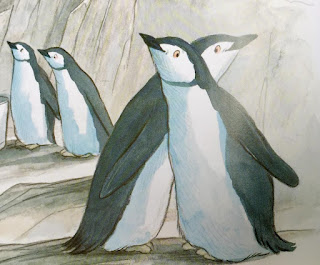 |
| Offensive necking? |
Maybe all hell broke loose though when Roy and Silo “wound their necks around each other.” To be clear, neither hugging nor kissing is mentioned. Certain adults might read all sorts of lascivious behavior into that, but a kid (whose development understands “boys” but not “males”) is going to think that’s the equivalent of joshing, play-fighting or putting their arms around one another. This is what primary students do. Who’s taking this to supposedly taboo terrain? I suppose it’s the one human character in the book, Mr. Gramzay, a zookeeper, who must finally make book banners rabid, when he “thought to himself, ‘They must be in love.’” Sounds sweet to me.
Typical young girl reaction: “Ahhhh” because any mention of love elicits that. Typical boy reaction: “Ewwww” because any reference to love is gross. This isn’t a knee-jerk homophobic response. Young boys are socialized to think lovey-dovey stuff is icky.
I’m having a moment, wondering how many book banners might be more like Silo and Roy than they’d like to believe, someday being reincarnated as penguins who would wait for their own rocks to hatch. Naturally, they’d dismiss the absurdity and heresy of such speculation since reincarnation is not a Christian concept. But I’m still wondering.
 |
| Ain't she cute... |
Eventually, Gramzay finds an egg that needs tending and sets it in Roy and Silo’s nest. They’d done such a good job of tending to a rock, after all. (Kudos, guys! It didn’t roll away!) Unlike the rock, the egg hatches. Gramzay calls the chick Tango, reasoning, “because it takes two to make a Tango.” Most primary kids won’t know that a tango is a dance so, whoever is reading to them can explain this. I suspect kids will just be happy that the baby was born. If anything, they’ll wonder why the egg came up as a spare during nesting season. The author’s note at the back of the book tells readers that the egg was one of two belonging to penguins Betty and Porkey, but that pair had never been able to care for two at once so, basically, one of the eggs would need to be tended to by other penguins to hatch. Seems like an above and beyond pro-life effort the book banners could have spun, but winding necks and loving “boy” penguins had already been duly offensive.
 |
Whoops! I'd forgotten about the "two daddies" reference. Really, it didn't register. I must have been still overcome by baby penguin cuteness. That's the "normal" takeaway. |
I’m sorry, it seems preposterously silly to get stirred up over this book and to seek to keep it away from children. There is no doubt that banning efforts have led to more young and older readers reading this book than would ever have been imaginable. For young penguin lovers—and, relax, easily triggered conservatives, I’m speaking generally of affection, not bestiality; what makes people’s minds go to such places anyway?—I’d recommend the picture books 365 Penguins, wherein a growing domesticated colony is content to be stashed in filing cabinets or stacked as pyramids, and Penguin and Pinecone, about another dopey main character who befriends, yes, a pinecone. It’s a super cute story, at least. (Where are the activists seeking smarter portrayals of penguins in children’s lit?)

Personally, I’m not giving the Tango book another thought. I’d rather spend twenty minutes reading old “Bloom County” comics, smiling over Opus and saving any offense for the antics of Bill the Cat. In fact, that’s exactly what I’m setting out to do…