Sunday, March 10, 2019

WARNING: DO NOT OPEN THIS BOOK!

Written by Adam Lehrhaupt

Illustrated by Matthew Forsythe

(Simon & Schuster Books for Young Readers, 2013)

This is a favorite book of mine for reading aloud. I begin by reading the title and heeding the warning. I don’t open it. I put it aside. My audience gets confused and restless as I pretend to consider another book to read.

They beg me to go back. I say, “Fine.” I reread the title and say, “I’m so sorry, but I just can’t. The thing comes with a warning.”

They beg again. Louder. More insistent.

Okay,” I say. “You asked for it.”

The inside cover artwork is a collection of signs. It’s worth stopping and reading them.

Oh, no.

Come on...seriously?

This book is super-dangerous.

Here is the last guy who read this book. [Arrow points to a skull.]

By now, a few are a tad scared but everyone is curious. The last sign on the page says, “Don’t turn the page” and I suggest we comply. I attempt to put the book aside again. A chant begins. “Turn the page! Turn the page!”

It happens every time.

After the title page, comes a danger sign with the head of a monkey. Maybe you should put this book back. You don’t want to let the monkeys out.

Monkeys!” I say. “This could get messy.”

They chant again. “Turn the page! Turn the page!”

This goes on, of course, until the monkeys appear.

We’d been warned.

Toucans, too.

And an alligator!

Yes, yes. We were warned.

Now we have to get everything under control again before we can close the book.

It’s pure mischievous fun.

Warning: This is not a book to read if you want a calm, quiet room. This is not a sleepy-eyed bedtime read. It’ll wake everyone up. Better than coffee. (Did I really just say that?!) Yes, yes. So true.

My favorite experience with this book came a few years ago as one boy declared it the best book ever. He’d regularly come to the principal’s office at lunchtime and beg me to read the book again. Then he began reading it on his own. He was a struggling reader but his fluency and expression improved through his repeated readings. I’d suggest he read it quietly so as not to alarm my stuffed animals. Of course, he read it louder and with even more expression. Then he asked if he could invite his friends to eat lunch in my office. He provided the entertainment with a well-performed reading of the book. He oozed with pride. He was both monkey tamer and accomplished reader.

There is a follow-up, Please, Open This Book! Same author, same illustrator. It picks up right where this book left off. By waiting a few weeks to introduce it, the kids jog their memories about all the goofiness of the first book. I reread it—how could I not!—before diving into the sequel.

This book brings huge smiles to the faces in the audience. It’s pure joy, a vivid, positive memory about a loud reading experience.

Find it. Be daring. Open it!

Thursday, March 7, 2019

THE BOOK ITCH: Freedom, Truth & Harlem's Greatest Bookstore

Written by Vaunda Micheaux Nelson

Illustrated by R. Gregory Christie

(Carolrhoda Books, 2015)

I love this book! This is the true story of Harlem’s National Memorial African Bookstore, its owner, Lewis Michaux and his young son, told from the son’s point of view. In the broader sense, it’s about feeding your brain and following your dream.

For Lewis Michaux, he wanted to open a bookstore in Harlem, but a banker refused his loan application. “Black people don’t read.”

And so, while saving his money, Michaux begins with five books and a pushcart. “Don’t get took!” he’d yell. “Read a book!”

Eventually he opens the bookstore, adorning it with African flags and all sorts of signs like, “THE HOUSE OF COMMON SENSE AND HOME OF PROPER PROPAGANDA.” People come, people read. The boy is awestruck in meeting famous patrons like Muhammad Ali and Malcolm X. A platform out front allows Michaux, Malcolm X and others to speak their truth.

As I read, my mind raced, planning another trip to New York, with this bookstore at the top of my must-see list. Sadly, I learned in Lewis Michaux’s biography at the back of the book that the store closed in 1975, after relocating once and then receiving eviction papers. On the same day I read this book, I walked in my neighborhood and happened upon a newly shuttered bookstore. Alas, book browsing havens are becoming more and more scarce.

The importance of the National Memorial African Bookstore should be readily apparent. What I also love about this story is how it shows the bond between a father and son and how this man, Lewis Michaux, is such a passionate advocate for literacy and knowledge. One passage particularly resonates today:
Me and my dad talk about important things.
Things like truth and what it means to be free.
Dad says books can help you. Not every book
is true, he says, but the more you read, the easier
it is to figure out for yourself what is true.

Christie’s illustrations are gorgeous, with warm-colored backgrounds and darker tones in the foreground. There’s an endearing image of Michaux falling asleep in his bookstore and a tasteful, powerful painting foreshadowing the news of Malcolm X’s fate.

Three days after first reading this book, I still feel a sense of melancholy that the place no longer exists.

Tuesday, March 5, 2019

A DIFFERENT POND

Written by Bao Phi

Illustrated by Thi Bui

(Capstone Young Readers, 2017)


A Different Pond is a tale of an early morning fishing adventure involving a young boy and his father. Through the main text, a particular illustration and an author’s note, we learn that the story is set in 1982 and the characters are based on the author’s own family, Vietnamese refugees who settled in Minneapolis. The story is told from the boy’s point of view. The fishing expedition is to bring food to the table rather than for sport. The family is struggling, with the boy’s father working several jobs and the mother riding a bike to work as the boys’ older siblings are entrusted to take care of him during the day.

Children will easily connect with early morning trips of their own as they hear the story. Early in the story we see the young boy yawning and trying to wipe the sleep from his eyes. There is something special about an outing that involves just father and son, especially when we learn that the boy is one of many children in the family. There are realistic touches that make fishing not as romanticized as it can be in other stories. For instance, when the boy’s father asks if the boy wants to put the minnow on the hook, the boy thinks, “I want to help, but I shake my head no. I don’t want to hurt that little fish, even if I know it’s about to be eaten by a bigger one.” Moreover, when the boy helps put a caught fish in the bucket, he makes a funny face as the fish feels “slimy and rough at the same time.”

There are some beautiful writing flourishes in the story, such as when the boy compares the nighttime stars to freckles and when he asks about his father’s brother who fought in the war and “didn’t come home”. While the father sometimes talks about his brother, this time he just looks away. Bui’s illustration beautifully captures the moment.

My only quibble with the text is when the young boy says, “A kid at my school said my dad’s English sounds like a thick, dirty river.” I cannot imagine a young peer offering such a complex simile. A more direct putdown would be more realistic and potent. (The boy himself thinks of his father’s English as “gentle rain”.)

The book is a great example for writers to learn the writing concept of “show, don’t tell”. How do we know the family is poor? The text refers to a “bare bulb” in the kitchen, mentions the boy’s father getting another job, includes his father’s lament: “Everything in America costs a lot of money” and mentions the callouses on the man’s hand and his broken teeth that flash when he smiles. The illustrator’s note mentions her intentional decision to have very few Vietnamese items displayed in the home. “[T]he empty spaces hold meaning, too.” (The comment invites another careful look at the pictures throughout the book.) Another illustration worth discussion shows the family’s parked car and the boy and his father heading to a pond in an area with a sign that reads: POSTED – NO TRESPASSING – KEEP OUT. It begs the questions, Do you think the father saw the sign? Why would he ignore it? Why would there be such a sign in the first place?

In all, this is a lovely, quiet book that can take the backdrop of a fishing trip and evolve into a rich discussion of family ties and the immigrant experience. The author’s and illustrator’s notes, as referenced already, are as important to shedding light on the story as the main text and pictures themselves.

Friday, February 8, 2019

YOUR ALIEN RETURNS

Written by Tammi Sauer

Illustrated by Goro Fujita

(Sterling Children’s Books, 2016)

I took an extended break from this blog and some true book gems didn’t get their due via an impassioned shout-out. One such book was Your Alien, a delightful tale of friendship and goodbye when a boy befriends an alien and everything seems perfect…until the alien becomes homesick. The book was a big hit whenever I’d read it aloud. I easily created an alien voice—a cross between Marvin the Martian and Beaker from The Muppets. 


Your Alien Returns allows the opportunity to get back into alien voice for a simple one-word utterance. On this occasion, the alien comes back and the boy ventures to the alien’s terrain with the promise to be back in time for dinner.

Now it’s the boy who must adjust to new customs, new games and a whole bunch of people—er, aliens—who are foreign to him. The connections for kids will be obvious. That time they had a sleepover at Wei Lin’s house, that birthday party for Keith on their baseball team where they didn’t know anyone else, that weekend they spent with their cousins in Tallahassee (or wherever…I just love the name Tallahassee). What do you do when excitement faces a sudden jolt of anxiety?

The book isn’t quite as fun as Your Alien. The cuteness of the alien isn’t such a novelty anymore. Still, how wonderful to take familiar characters and have them deal with, well, the unfamiliar. Track down Your Alien (Sterling Children’s Books, 2015) and follow up a week later with this book. Kids will cheer to see the alien once more.


Tuesday, February 5, 2019

WILD THINGS

PETUNIA GOES WILD
By Paul Schmid
(Harper, 2012)


WILD FEELINGS
By David Milgrim
(Henry Holt and Company, 2015)

Kids easily connect to wild animals. Running around, roaring and growling, is incredibly freeing. (Why did we ever stop?)

I’m a big fan of Paul Schmid’s Petunia. I first discovered her in the delightful A Pet for Petunia when she begged and begged her parents for a pet skunk. As a teacher and principal, I often carried the book from classroom to classroom, one of my Stack of Five. (I do a quick book talk about five picture books and then let the audience vote to determine which one I read aloud during the visit.) Sadly, the book was rarely chosen no matter how much I talked it up.

It seems Petunia is an in-between character. On the cover of each book, she wears a purple and white striped dress. Sadly, I suspect that the color and her gender caused many of the boys in class to withhold their vote. They say boys are less inclined to warm up to books with girls as the main character; I’m intent on changing that. I think many of the girls don’t vote to hear about Petunia because she’s not stereotypically girlish. She’s more Olivia (the pig) than Belle (the princess).

I often read A Pet for Petunia as a “bonus read” after the top vote getter. (“But it didn’t even come in second,” someone always says. Ah, let’s expand our horizons.)

Like it’s predecessor, Petunia Goes Wild works best as a read-aloud when you’ve read it to yourself a couple of times. You want to nail the part of Petunia. There are stereotypes to be broken, after all. Petunia has a stuffed animal that’s a lion and—no, she doesn’t want a pet lion this time around. Rather, Petunia is a lion. She roars at passersby from the front yard, she crawls and eats from the floor, she even bathes in a mud puddle. So very lion-ly.

For a parent, all this feral, feline behavior can be problematic. As in A Pet for Petunia our feisty, persistent main character eventually drives her parents to utter exasperation. There is an incredibly wordy page that is the most fun to read out loud. It’s a classic parental rant.

And, as a read-aloud, at least, kids love it. They all have parents who’ve succumbed to a rant.

Petunia is both genuinely funny and wildly imaginative.

The cover photo of David Milgrim’s Wild Feelings shows the main character—a boy this time—dressed as a lion, mouth agape in full roar. Milgrim goes through a series of familiar similes, comparing feelings to animals.

Do you ever feel...
as stubborn as a mule?

Or as chicken
as a chicken?

This is a book for kids—especially boys—to connect with a range of often negatively viewed feelings. It’s a springboard for talking about them and normalizing them.

So what’s an acceptable thing to do when you’re “rrrrrreally mad”? How do you recover when it’s all over, when perhaps things didn’t go so smoothly while you were in the midst of the mood?

Picture books like this not only entertain, but they open the door for talking about more difficult things. They can be reference points after the fact as well. (Remember that book we read about...?) If kids can name their feelings and talk about them, the “bad” feelings won’t go away but they’ll learn how to work through them (more appropriately over a period of time). They’ll also give their temperamental friends some support and/or space when they’re in such a mood.

I’m wild about both these books. Track them down and have a roaring good time sharing them with the kids closest to you.

Friday, February 1, 2019

AFTER THE FALL: How Humpty Dumpty Got Back Up Again

By Dan Santat

Roaring Brook Press (2017)


In After the Fall, Dan Santat takes classic nursery rhyme character Humpty Dumpty and imagines that all the king’s men managed to put him back together again. Give or take a few bits and pieces.
In truth, poor Humpty, who loved sitting atop walls—to be closer to the birds—is a little broken. There’s a heartbreaking image of the bandaged egg sleeping on the floor in his room. Seems he’s too scared to climb the ladder to his bunk. Moreover, he dares not reach for the upper shelves in grocery stores where the truly tasty cereals like Just Marshmallow and Sugar Elf are stocked. Sadly, that leaves him to the bland brands on the lowest shelf—cereals with names like Fiber Flakes and Grown-Up Food. (Poor Humpty, indeed!)
Santat’s lovely, whimsical illustrations are cast in darker, muted colors with a range of perspectives from over-the-shoulder shots to aerial views. Every page invites the viewer to pause and study the images.
In time, Humpty Dumpty makes do, making paper airplanes. If he can’t reach higher altitudes, at least his creations can. And then one day, dear Humpty must face his fears. Something precious forces him to consider ascending a ladder and being atop the fateful wall once more. Can he do it? And will nursery rhyme history repeat itself?
This is a wonderfully endearing tale of resilience with a surprise ending that makes the reader want to immediately reread the story now that he is in on some nuances of the story that should have been (but weren’t) obvious. By golly, Santat manages to shed light on both the classic story and his reworked sequel of sorts. The result is absolutely delightful!

Friday, November 2, 2018

BOYS WHO WEAR DRESSES


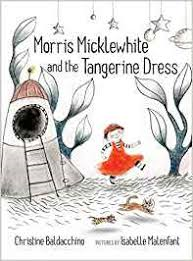
MORRIS MICKLEWHITE AND THE TANGERINE DRESS
Written and Illustrated by Christine Baldacchino

(Groundwood Books, 2014)


10,000 DRESSES
Written by Marcus Ewert
Illustrated by Rex Ray

(Seven Stories Press, 2008)


There are books that make me wish I weren’t taking a leave of absence as an elementary school principal. There are funny ones I long to read to a group of eager kindergarteners or a room of resistant grade sevens. There are captivating picture books with a-ha moments that require an immediate second read to marvel over how the author surprised the audience. And then there are the teachable books, the ones with insights that build awareness and transform the reader with new understandings. Morris Micklewhite and the Tangerine Dress and 10,000 Dresses are two books I’d like to workshop, with staff, with students, with parents. Fictional characters like Morris and Bailey can make the lives of many real people a little easier.

First up, Morris. He lives with mother Moira and his cat Moo. (Yes, the alliteration is a little heavy at the get-go.) Morris is one of those youngsters who likes many things. “Mondays are great,” we are told, “because on Mondays, Morris goes to school.” So many of the things he likes happen there. What Morris likes most is center time, when he chooses to play dress-up. That’s when he gets to wear the tangerine dress which “reminds him of tigers, the sun and his mother’s hair.” He loves the swishes and crinkles he hears while moving in the dress and the click, click, clicks from the shoes he wears with it. But, “[s]ometimes the boys make fun of Morris. Sometimes the girls do, too.” Soon Morris doesn’t want to go to school.

On the title page of 10,000 Dresses, we see Bailey, smiling and wearing a simple white t-shirt and underwear. The message: this is a boy. But the story opens, perhaps jarringly with, “Every night Bailey dreamed about dresses.” There’s some awkward language about a stairway in a “red Valentine castle” that had me frowning, but this is more of a message book than a literary marvel. Bailey’s dreams involve dresses of rainbow-flashing crystals and lilies, roses and honeysuckles. Her dreams are instantly dashed by her parents. (Yes, this 2008 book uses preferred pronouns of she and her for Bailey.) “You’re a boy,” his mom says. “Boys don’t wear dresses!”

And Bailey’s response is heartbreaking: “But...I don’t feel like a boy.”

There have always been Morrises and Baileys. But, in my day, they would have to change. They would have to don and dream of dresses in secret. Either that or the bullying would be relentless, stretching from kindergarten to the great beyond. Morris would be mocked as “Margaret.” “Melissa.” Or the much-maligned, all-purpose sissy taunt: “Nancy.” But we’re in a time now when most would recognize that it’s everyone else that needs to adjust. Morris is just being Morris. Bailey can be whoever she wants. Why should anyone have a problem with that?

Sadly, they still do. As early as kindergarten, boys know to avoid pinks and purples and to leave the dolls alone in the play centers...unless they are being used to fire out of a make-believe cannon. Gender roles are established, whether it’s due to nature, nurture or a combination.

A colleague of mine shared how she refused to buy toy guns or other weaponry for her two boys and yet, even before they learned to wave, they were using their thumb and index finger to form a quick-draw gun. Bang! Bang! As I shopped for my cousin’s baby shower this summer, I was dismayed that so much, from cards to gift bags to stuffed animals, came in pink or blue. Baby Jack’s nursery is painted green and adorned with gray whales, crabs and octopuses. (Side note: turns out octopi is an “improper plural”.) I am further reminded of a fascinating New York Times article about trying to reverse gender roles and also teach gender neutrality: “In Sweden’s Preschools, Boy Learn to Dance and Girls Learn to Yell”.

Some may indeed be entrenched in their typical male or female gender identification. The point is to open their eyes to the fact it’s okay for others to express themselves differently and to open the door for others to explore a more fluid or less typical gender identity.

These are important books to read and discuss with children, perhaps more than once over a period of years. Despite greater awareness of Morris and Bailey, gender-role and gender-identity defying boys remain a minority. It is easy for peers to find their behaviors and preferences queer, in the “odd” sense of the word. If a child’s first reaction—i.e., a boy wearing a dress is odd—is not elicited and accepted, then the opportunity for transformational learning decreases. A child may listen to the story and go away unchanged, still reacting critically when he or she observes another child acting outside of gender norms. Ridicule may go underground. Then it’s a burden for the targeted child to have to muster the courage to report or to have bear in on his own. Books like these seek to increase awareness and acceptance to reduce burdens. They also provide safe reference points for parents, teachers and children. “Remember when we read that book about Morris and the orange dress...?”

Both books are worth reading, perhaps a week or a month apart. (Pull out the first book to read another time after the later reading of the second book.) It helps kids to know that Morris Micklewhite and the Tangerine Dress (or 10,000 Dresses) isn’t some one-off book. There are positive traits about both characters that should be elicited from the reading audience. The boys-wearing-dresses images may be vivid takeaways but there is more to admire about Morris and Bailey.