Wednesday, May 1, 2013

TOO MANY TOYS

By David Shannon

(The Blue Sky Press, 2008)

Whenever I think of toys, my mind wanders back to law school and a certain professor who pined to be a stand-up comedian. He talked of growing up on a farm with no real toys. His mother let him play with two potatoes...until it was time to make dinner. Toy trauma ensued on a daily basis. The scenario always makes me smile and, although I firmly believe he had a mighty pampered childhood, I think one could have oodles of fun with potato adventures. Yes, go ahead and play with your food.

Seeing the title Too Many Toys on a shelf in my school library, I had to scoop it up. A David Shannon creation? Even better!

Spencer is a boy with toys in abundance. You get an idea of just how many when Shannon says, “Spencer liked to make his toys into a parade that stretched from one corner of the house to the other and back again!” Apparently Toys “R” Us has set up shop in a private location.

Children, of course, outgrow their amusements. See “Toy Story”, listen to “Puff the Magic Dragon”, read “The Giving Tree. But there is that awkward moment in time when parents realize certain toys no longer serve a purpose and when a child strongly disagrees. Suddenly every toy destined for the discard pile becomes a beloved keepsake that must remain for all eternity...even if the head is missing, the windup mechanism busted or the dog (Fergus?) chewed the little green army into a grossly disfigured hospital unit.

D Day (Discard Day) finally comes. After one too many toy trippings, Spencer’s mom yells, “YOU HAVE TOO MANY TOYS!”

That’s impossible! thought Spencer.

Then she said, “We’re going to get rid of some of them.”

That’s a CATASTROPHE!

Battling, bickering and bargaining ensue, with an ending not unlike my law professor’s potato story.

As always, David Shannon’s illustrations bring the story to life. The toys will cause any reader, young or old(er), to stop and imagine all the potential fun before turning the page. Shannon skilfully honors a time in our lives when imaginative play was the order of the day while also showing children the parents’ perspective. Shannon throws in a few nuggets about different kinds of toys. Here’s a potent example: “He had...talking books that fueled his mind...and loud, jumpy, frenzied video games that didn’t.”

Too many toys will always seem like a preposterous concept to a child but it makes for an entertaining read.

Sunday, March 3, 2013

HUFF & PUFF


By Claudia Rueda

(Abrams Appleseed, 2012)

Okay, this is an “Ahhh” book. Very cute.

It’s a retelling of The Three Little Pigs with, quite literally, a SURPRISE ending.

Even before “Babe”, I’ve been charmed by pigs. Perhaps it goes back to Wilbur in E.B. White’s “Charlotte’s Web.” Maybe it’s a fondness for a certain Muppet. Whatever the case, I’ve always been entertainingly anxious whenever a certain wolf ventured into the piggy homeland. Twists on thetraditional tale are always welcome.

Claudia Rueda breaks the familiar story down into its simplest terms. 

First pig building a house.

First pig inside the house.

Thanks to Rueda’s endearing illustrations, the pigs are particularly delightful—and amusing—in the aftermath of the wolf’s visits.

This is such a quick read, I initially balked at paying a good chunk of change to buy the picture book. But then I realized I was still smiling and chuckling as I wandered into another aisle of my favorite children’s bookstore. I knew I had to backtrack and add the book to my cart.

A smile is most definitely worth it!

Sunday, February 24, 2013

REALLY AND TRULY


Written by Émilie Rivard

Illustrated by Anne-Claire Delisle

Translated by Sarah Quinn

(Owl Kids, 2011)

This is the story of an endearing relationship between a young boy named Charlie and his grandfather.  Grandpa entertains Charlie with far-fetched tales about witches and pirates and gnomes. Each story is punctuated by Grandpa’s assurance that what he says is true, “really and truly.” Charlie is enchanted each time.

But only a few years later, things change. Sadly, Grandpa is not his old self.

An awful disease has eaten up his memory and his words. It has even swallowed up his smile.

Charlie struggles to understand why his grandfather has changed.

When we walk in his room, he doesn’t even turn around. The cars driving by outside are more interesting than we are.

It is a heartbreaking reality that too many families must face. Young children don’t understand, just as I felt insulted when my great-grandmother called me Reggie. She got most of the letters right, just jumbled them up.

Due to the change in Grandpa, Charlie becomes the storyteller. He retells his grandfather’s stories about ninjas and hunters. He even makes up his own tales in an attempt to reach his grandfather. Grandpa responds by looking, by eating and, on one special occasion when Charlie pulls out every trick he can imagine, smiling.

Rivard’s story provides a starting point in helping children understand dementia and Alzheimer’s. Delisle’s illustrations, particularly her drawings of Grandpa, will increase empathy in kids. (My one quibble with the illustrations is that the tiny black ink doodles of toads, gnomes and ninjas distract from the main subject matter.)

Really and Truly is a touching story that will enlighten children and linger with adults.

Thursday, February 7, 2013

PENGUIN AND PINECONE: A Friendship Story

By Salina Yoon

(Walker Books for Young Readers, 2012)

Haven’t we all made fast friends with someone who happens to be at the same sandbox but actually lives in a distant land (like the suburbs)?  Haven’t we all begged to have the toad or the ladybug in the backyard garden become our newest, most beloved indoor pet?  Please, mom!  But why not?!  Sometimes staying connected just isn’t practical.

This book celebrates an unusual friendship, springing from an immediate bond when Penguin discovers “a curious object” on the ice:  Pinecone.  Immediately, Pinecone becomes more than a toy; Pinecone is a friend.  Penguin knits a scarf for his new friend and wraps it around Pinecone to keep him warm.

Still, something seems to be wrong with Pinecone.  Penguin’s grandfather has to explain what is literally the cold, hard truth:  “It’s too cold here.  Pinecone belongs in the forest far, far away.  He can’t grow big and strong on the ice.”

And so Penguin sets off to take Pinecone to a better home.  The image of Penguin finally leaving the scarf-clad Pinecone will touch even the most cold-blooded being, especially since Penguin goes to the trouble of leaving a special message on the ground.

When Penguin grows up, he still wonders about his friend so he makes the long trek back to the forest.  Once again, the image is precious, as is the book’s final message.

A few times I year, I discover a picture book that I can’t stop talking about.  I share it with everyone I see.  This is one of those instant treasures.  I keep it in my knapsack and pull it out at Starbucks, before the movie starts and after we’ve given the waiter our order.  (Today, I took it out while attending a conference and insisted that complete strangers give it a read.  Since they didn’t move to another table, I assume I didn’t alarm them too much!) 

With simple text and uncluttered illustrations, Salina Yoon’s message is clearly conveyed.  I have a good sense of when people are merely indulging me and when they are truly entertained.  This book has been a big hit with everyone.  You’ll look at pine cones in an entirely different way...maybe even name one Sally or Chuck.  As for me, I just might take up knitting.
Penguin and Pinecone is a pure pleasure!

Sunday, January 27, 2013

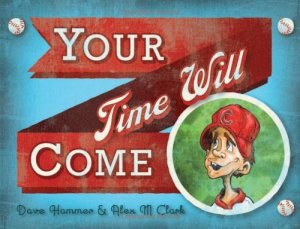
YOUR TIME WILL COME


Written by Dave Hammer

Illustrated by Alex M. Clark


Boys, dads and baseball. There’s a reason this is a common combination in children’s stories. So many boys have strong, positive memories of breaking in a baseball glove, playing catch with dad in the backyard. The associations continue at the baseball diamond.

In many ways, Your Time Will Come follows the typical baseball story structure:  a boy isn’t “good enough” and becomes a benchwarmer until the final inning of the final game of the season, score tied, two outs. Suddenly, all eyes are on the one boy who has been chronically overlooked. As familiar as the setup is, I still found myself routing for Chad at bat. The drama is always there.

The focus of this story is not Chad’s interactions with the coach or his teammates. Instead, author Dave Hammer sticks to the father-son relationship and their connection to baseball which begins to grow while Chad is still in the crib. All along, Chad’s desire to play baseball is palpable. It’s the execution that needs to be nurtured. For every setback Chad experiences, his father is there to offer encouragement:  “Your time will come.”

Hammer adds a clever backup supporter to echo and illuminate the father’s words. Indeed, this is the first book I’ve read in which the “@” key on a computer becomes a character. While boys will appreciate the technological tie-in, fathers will more fully understand the computer key’s own story.

The illustrations of Alex Clark are a true highlight of Your Time Will Come. They have a nostalgic feel, in part based on the style of the uniforms. As one views the illustrations, one thinks of a simpler time which still bore the pressures and yearnings to belong and to succeed. Moreover, parents will identify with the expressive, irrepressible look on the father’s face as he stands over infant Chad’s crib and dreams of his son’s future.

Your Time Will Come is as much a book for boys as it is a thank you gift to fathers from grown sons who look back fondly on precious moments spent with dad. Hallmark might not like the suggestion, but this book would be far more meaningful and memorable than a greeting card. Father’s Day is less than five months away.

Monday, January 14, 2013

NOT NORMAN: A GOLDFISH STORY


Written by Kelly Bennett
Illustrated by Noah Z. Jones

(Candlewick Press, 2005)

What do you do when your pet isn’t fun enough, cuddly enough or adorable enough? What’s the point?

That’s how the boy in this story feels. Norman, his pet goldfish, is just not enough. How can a goldfish compare to a puppy, a kitten, a gerbil or a lizard? The boy decides there is no comparison. He’s trading in Norman for a real pet.

If you are an animal lover, the premise will keep you invested throughout the story. Will the boy really give up the goldfish? And why is the fish all alone in a tiny fishbowl?

Poor Norman!

Other pets in the story get more attention. Austin has a dog with lick-everything puppies. And Emily has a snake that get’s EVERYONE’S attention. Norman? He just glug-glugs water and stares blankly from his bowl. Why would anyone notice him?

Thankfully, the boy does begin to notice little things, endearing things. Nonetheless, the boy doesn’t back down from taking the goldfish to the pet store. Oh, my! Surrounded by cats and birds and hamsters, how does Norman stand a chance?

The illustrations are digitally created and have the same strengths and weaknesses I see in so much digital art. While the main images are appealing—I particularly like the silhouette images of the other musicians during band practice—the backgrounds often seem like nondescript afterthoughts, reminding me of the old “Flintstones” cartoons as Fred and Barney would run on and on through a never-ending interior with the same plant and painting in the background. The lack of interest affects the overall impression of the illustrations. I am curious if other picture book fans have also noticed this as a trend. I encourage you to add your thoughts in the Comments section after the post.

This is a story that had me wholly invested from the start. Having volunteered at the SPCA, I was horrified by the concept, yet too aware of how realistic it is. People abandon their pets too easily. The pets get too big, too chewy, too whiny, too piddle-prone. It is all too easy. Drop off and drive away.

Not Norman should trigger a great deal of discussion about pet ownership and pet care.

Monday, December 31, 2012

THE GIRL IN RED


Written by Aaron Frisch

Story and pictures by Roberto Innocenti

(Creative Editions, 2012)

After my first read, I knew I would not feature this book as a recommendation.  I did not like the ending.  Indeed, it was not appropriate.  Too dark.

But then I went for coffee and recalled earlier versions of “Little Red Riding Hood”, the story upon which the book is based.  In some tellings, the grandmother got locked in a closet, but in others, the wolf ate her.  Red Riding Hood often suffered the same demise.  Then, the woodsman cut open the wolf, rescued the remarkably unchewed characters and stuffed the villain with rocks, leaving him to die.  Happy endings?  No nightmares?  Maybe this is why night lights were invented.

Here I go.  I’ll feature the book and you can decide if it suits you.  The story begins with a strange grandmotherly doll plopped in the middle of a table as children gather round to hear a story on a rainy day.  The narrator (the doll) tells us:

Our story takes place in a forest.

This forest has few trunks and leaves—it is composed of concrete and bricks instead.

Yes, we’re in a city in modern times.  Sophia is “a quiet girl” who lives in a rundown tenement with her mother and younger sister.  Since Sophia’s grandmother is unwell and wants company, Sophia sets off for the “other side of the forest,” first putting on a red hoodie as there is a possibility of rain.

Sophia’s mother cautions her to stick to the “main trail” the entire way.  Indeed, it’s a grim route, littered with trash, graffiti and a chalk-drawn body behind police tape.  A mall proves a distraction and then Sophia does what we’ve all done:  she exits through the wrong doors.  This leaves her disoriented and vulnerable in an even seedier area.

Taunted by some no-goods, she is “rescued” by a motorcyclist with big teeth.  Ultimately, he ditches the girl and gets to nana’s house in advance.  An unhappy ending results.

 This is a reminder of stranger danger, a tale to warn kiddies to never let down their guard.  Still, common sense should have prevailed.  It appears to be a long, long journey through the worst parts of the city.  I cannot imagine a parent allowing a young child to make the trek alone. 

The illustrations portray dark scenes with bursts of color.  Roberto Innocenti’s illustrations are the true highlight of the book.

Author Aaron Frisch offers an alternate happy ending after we see the story audience weeping around the doll.  After all, we are told, “Stories are magic.”  I doubt the book would have been published without this add-on which leads me to wonder if the grimmer work of the Brothers Grimm would reach the marketplace in today’s Disney-fied world.  If nothing else, this is a book to begin a discussion on whether grit and darker aspects of reality have a place in children’s picture books.  I have featured some darker books (Way Home; Riding the Tiger; Bird) and enthusiastically recommended them.  But is scaring children about strangers the way to ensure they are safe?  My uneasiness remains, but I welcome your comments.