Wednesday, December 14, 2011

CHANGING THE CHECKOUT RULES

I’m guilty.

I hold onto my library books for too long. I stop in every weekend to return a few and checkout more than a few. Yet for some reason, there are other books that sit at home. They are ones that I thought might be interesting, but I still haven’t opened. I conveniently renew them online. The initial three-week loan extends to six. Often, I take advantage of the second renewal, thus keeping a book for up to nine weeks.

I’m not talking so much about novels. The neglected stack is mostly picture books. I can’t explain my library-condoned book abuse. The best I can do is compare these books to mustard or mayonnaise. I do not know why, but in my family no one ever bothered to flit a knife way down into the bottom of the jar to scrape out the final product that might complement one, two, even three more hotdogs. If the jar sat on the fridge shelf for another week, it might as well sit there for another year. No one would touch it. We might open a new jar or simply go without. Double up on ketchup and relish.

The renewals don’t matter. The books won’t get read. Still, I hold onto them just in case. I am not completely callous. Occasionally, I feel a pang of guilt. If I keep Merry Christmas, Splat for the maximum term, no child will get to enjoy it during the Yuletide season. Abominable!

Just admitting this ghastly habit of mine helps. I have a stack of books due tomorrow. I can again renew them online, but instead I resolve to go sift through them tonight, read the ones that still pique my interest and load the rest in the car. I shall no longer be the library scrooge!

Why must every book have the same renewal period? I am one of the shrinking number of people who still rents DVDs. Some are one-night rentals, others can be had for three days and my tried and true favorites can be kept for a full week. I do follow the rules. If the newest books had shorter terms, I would get to them sooner. The shorter term ups the impression that they are must-reads. Give me no renewal option for the newbies to the collection. This is just the kind of nudge I need.

I have worked with my school librarian to launch a One-Night Reads program, a small-scale change to book checkouts. We selected ten newer, highly appealing picture books for which we wanted to create a greater buzz. This year, we are trying to get the books in fifty homes. Next year, we’ll select new titles and aim for one hundred home visits. Students are keen. They vote for which books they hope to have a chance to take home for a night. Names are announced each morning and as books are picked up or delivered, the student grin broadly as classmates say things like, “You won!” As an increasing number of students read these books, there are more common discussions about these particular stories and characters. These books have status. The love for reading increases.

Quicker returns will not work for all books. As a browser, I may shy away from 1Q84, Wonderstruck and other massive tomes. A librarian, of course, can determine which books require full reading terms even as a recent arrival. More work at a time when deep cuts are being made to library funding? Yes. Still, the result is a positive one. Shorter terms for newer titles will get books read more and bring us back to the library sooner to pick more books. No guarantee that the books will be read, but we do increase the chances. We have to stop treating each book the same.

I cannot be the only one who would welcome a rule change, can I? What do others think?

Tuesday, December 13, 2011

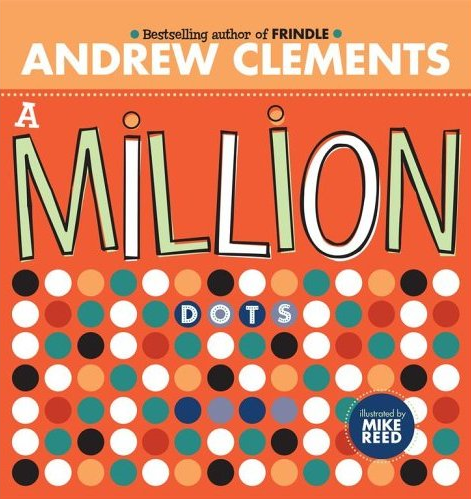
A MILLION DOTS


Written by Andrew Clements

Illustrated by Mike Reed

(Simon & Schuster, 2006)

For young children, waiting ten minutes for the cookies to bake can be agonizing. The forty candles on a birthday cake is unimaginable. Picking up fifty-two scattered playing cards after an abandoned game of Go Fish is an arduous task that may require a few breaks before completion. How do they make sense of bigger numbers? How do they understand one million?

Kids do like big numbers. They just need some support in making sense of them. (When I taught math, I often put a dollar sign in front of a larger calculation task. Suddenly, a task that seemed too hard became an exciting challenge for future bankers.)

Popular children’s book author Andrew Clements has decided to give more meaning to larger numbers in A Million Dots, a nonfiction picture book beautifully illustrated by Mike Reed. He starts with one dot, easily overlooked unless pointed out at the center of a page. “One dot is not very many. It’s only one, and that’s just one more than none.” After showing arrays of dots to represent 10, 100, 500 and 1,000, the book takes off on a journey to 1,000,000. Dot grids are superimposed on Reed’s digital illustrations. At the bottom of each page, Clements highlights a numbered dot on the page. With a splash of yellow surrounding a fact box for the number 1,860, he informs us that, “A person must climb 1,860 steps to walk to the top of the Empire State Building.” If you scan the picture, Dot Number 1,860 is circled in yellow.

The dots accumulate from page to page. Some facts are informative. “More than 265,000 different kinds of moths and butterflies live on Earth.” Others are seemingly randomly constructed, but the illustrations complement the contrived fact. “It would take 464,000 school-lunch cartons of chocolate milk to fill a 20-by-40 swimming pool. (Please pass the straws.)” Clements knows what topics will appeal to kids. In addition to chocolate milk, he imagines loading baseballs onto semitrailers, weighing a group of T-rex dinosaurs and hauling cars to junkyards.

As this is an American publication, there are no Metric figures but that is not a major issue. The book is intended to give children some sense of seemingly gigantic numbers. It is not a tool for teaching pounds or kilograms.

Since the facts are not connected to one another, children may lose interest unless supported while reading the book. I would suggest reading each fact aloud and having children try to visualize the fact topic on their own before repeating the statement while showing the illustration. Allow time to talk about each fact. Jot down each number on a pad or on a blackboard so the reader/listener can track how the numbers are growing.

As a teacher, I would bring out the book on another occasion during math class. Help students create number lines from 0 to 1,000,000, marking every hundred thousand. Assist them in estimating where each featured number falls on the line and then mark each line with a key word from the trivia fact (e.g., moths for 265,000; toothbrush for 839,500). This will help them get a better sense of scale while also allowing the facts to stick a little longer.

I also loved teaching pointillism in art classes. Sometimes students would feel overwhelmed in painting or drawing so many dots. (Tip: Snipping off the cotton end of a q-tip and dipping the remaining straw in paint had more appeal.) A Million Dots would be a wonderful resource to pull out when introducing pointillism and for “comforting” students with the assurance that their finished work needn’t have nearly as many dots.

In sum, A Million Dots is a great literature connection to mathematics and to random, yet interesting trivia.

Monday, December 5, 2011

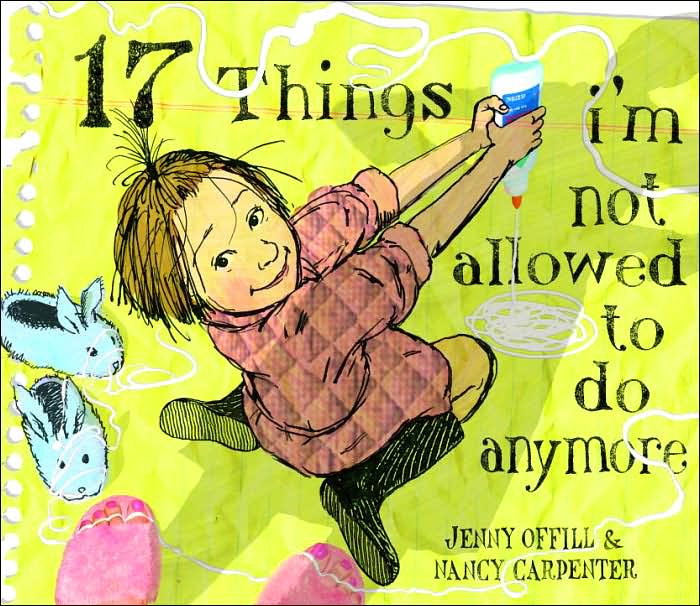
17 THINGS I’M NOT ALLOWED TO DO ANYMORE

Written by Jenny Offill

Illustrated by Nancy Carpenter

(Schwartz & Wade Books, 2007)

This is one of those dangerous books. In the wrong hands, it will bring new, sparkly ideas to any already sparkly minded boy or girl. Pity the younger brother, the mother or the teacher of that child. Fortunately, most readers will chuckle as they live vicariously through the curious mind of the protagonist (antagonist?).

At home, this girl wears her pink robe; at school, she is the only one who arrives in uniform: buttoned to the top yellow blouse and plaid skirt. But she is neither prim nor girly—at least, not in the stereotypical sense. What makes her really stand out are the black galoshes she clomps around in and the unkempt hair, complete with a tuft that intentionally sticks straight up with the help of a rubber band. This is a girl who, in her desire for sameness, will always be different.

The book is exactly what the title states, a list of intriguing ideas acted out but once. Jenny Offill’s text grabs us from the first page spread: “I had an idea to staple my brother’s hair to his pillow. I am not allowed to use the stapler anymore.” Naturally, she moves on to restricting her sibling with glue. This is a child who requires an ever-expanding set of site-specific rules.

Nancy Carpenter’s illustrations which combine pen-and-ink drawings with digital media are highly engaging. She perfectly captures the girl’s expressions such as her delight and concentration when trying to walk to school backwards. There are extras on the pages (e.g., the pen stain on the principal’s shirt; the cover page of a report on George Washington that somewhere along the way changed to an obviously more compelling assignment on beavers).

At times, the writing loses some zing through its too literal yin yang between the idea and the new rule. For instance, “I had an idea to walk backward all the way to school. I am not allowed to walk backward to school anymore.” The action and reaction are realistic. This seems to be a child who cannot generalize some of her learning. Still, the amusing ideas warrant more creativity in the writing.

I have not read this book aloud to any class due to one of the pages (which, I suppose, I could easily skip). We see the girl doing a handstand along with the words, “I had an idea to show Joey Whipple my underpants.” Yes, this may be true to life, but it strikes me as creepy to have the school principal playing it for laughs with a young audience. I would love to know other people’s thoughts. Feel free to post a comment.

Friday, December 2, 2011

A FINE, FINE SCHOOL


Written by Sharon Creech

Illustrated by Harry Bliss

(Joanna Cotler Books, 2001)

Hard to believe I have waited so long to blog this book. This title should be prominently displayed in every school library and in every principal’s office.

Mr. Keene is the principal of Fine Elementary School. He marvels at all the wonderful things that happen there. The children learn amazing things. The teachers instruct in amazing ways. He cannot contain his excitement and his pride. He cheerily pronounces, “Aren’t these fine teachers? Aren’t these fine children? Isn’t this a fine, fine school?”

And how nice it is to hear a principal speak so positively!

Mr. Keene decides you can’t have too much of a good thing. Imagine, if students are thriving so much at school, then the only possible way for things to be better is—this is where I pause during a reading—to have MORE school. Hooray for school on Saturdays! And since I am a principal, I always comment on what a fine idea Mr. Keene has. I jump up and grab a pencil and paper to jot down this wonderful idea as some students are intrigued, others horrified.

It doesn’t stop there, of course. Since students learn even more with school on Saturdays, Mr. Keene takes the more is better principle to the next level...and then the next. Everything is fine!

My audience laughs and squirms as I continue to jot down all Mr. Keene’s fine ideas.

Thankfully for us all, author Sharon Creech prominently features another character in A Fine, Fine School. Tilly is a student at Fine Elementary. She has a younger brother and a dog named Beans who do not go to school. With all Tilly’s time spent in school, there is less time to be with her brother and Beans. It is up to Tilly to help Mr. Keene see things from another perspective.

This book always entertains students. They can all connect to the subject. They can all imagine being Tilly’s classmates. And, yes, they can easily imagine me implementing Mr. Keene’s ideas. After all, I do go on and on about the wonderful students and teachers at my school.

Sharon Creech has come up with a golden story. The illustrations by Harry Bliss add to the humor. Indeed, this picture book is a terrific example of how the pictures don’t just illustrate the words; they add to the story. Here, Bliss provides visual details, from the attention grabbing Post-its on Tilly’s backpack on the cover (e.g., “MASSIVE TEST ON YOUR BIRTHDAY”; “GYM TEST TODAY”) to the antics of children on the bus and in the classroom. The dog, Beans, is a scene stealer wherever he appears. Call attention to the extras in the first drawings and students will eagerly act as picture detectives for the rest of the book, eagerly pointing out and laughing at their discoveries.

I am sure every reviewer makes the obvious statement: This is a fine, fine book. However, that undersells it. This book is one of my personal treasures. The sentiment is one that I hope to honestly convey at every school where I work.

Friday, November 25, 2011

STRAIGHT TO THE POLE


By Kevin O’Malley

(Walker & Company, 2003)

This is a wintertime favorite. It is for all of us who have experienced the dressing ordeal and restricted movement that arises from wearing an undershirt, sweatshirt, sweater, long underwear, pants, winter coat, snow pants, double socks, boots, mittens, scarf and toque.

It’s hard to even introduce the story without giving away too much. I can at least say that this is about a boy who, fully geared up, sets out on a dangerous trek through snow, wind and ice. It’s a classic conflict: boy versus nature (and snow gear). Be assured, however, that the story, told with sparing text, is highly amusing. This is the kind of character who would make any household or classroom extraordinarily entertaining. This is the kind of boy who would steal the scene in the class play...even when he plays the scenery.

As a read aloud, you will want to employ your own overacting skills. Draw things out. Take in the smiles and giggles of your audience. I have no doubt that after you finish this reading journey and the chatter likely to result from it, you will want to immediately reread it again to satisfy your eager audience...and yourself.

You really must track this book down. Highly recommended!

Tuesday, November 22, 2011

HAVE I GOT A BOOK FOR YOU!


By Mélanie Watt

(Kids Can Press, 2009)

It’s a good thing I wasn’t a rich kid. I would have bought enough “Must-Have” toys and gadgets to create a mountain of abandoned playthings in the back yard. Unsightly in summer, a skiing attraction come winter. On Saturday mornings, I watched cartoons and paid as much attention to the commercials as I did to that always-“menacing” group of sleuths on “Scooby Doo.” Every ad made a compelling pitch, convincing me, This toy is the best ever! (Even better than the sea monkeys I sent away for in the summer and the miniature Spirograph kit I received the week before after saving box tops!) I was part of the key demographic group for every marketer: the gullible.

As the cover of Have I got a book for you! makes clear, popular children’s author Mélanie Watt has her own selling to do. This is a pitch I can still get excited about. Buy a book! To be very specific, but THIS book! Al Foxword, a plaid-jacketed, bow-tied salesman (sales-fox?) pours on the pressure tactics. You need this book! You REALLY do!

Young readers will enjoy the goofiness. Older students could use the book as a springboard to talk about consumerism and needs versus wants. Many classes participate in book order programs and I often shake my head as the orders come in, flimsy books that come with cereal box prizes outselling the genuinely compelling stories on the list. (Yes, they’re excited. They’re buying books—or plastic necklaces that come with books. But will the books they get turn them on to reading or turn them off?)

As a published author, I cannot help but find a dark side to Have I got a book for you! If Watt has to cheekily work so hard to shuck her book, what about us lesser known writers? And, more generally, isn’t it sad that we have to expend so much extra energy to promote books, to defend the importance of libraries and to argue against prominent newspapers that predict the death of the picture book? This title rings too true. Perhaps that is why I prefer Watt’s later book You’re Finally Here!, a celebration of books and reading without the business of bookselling in the forefront.

Monday, November 21, 2011

I'M NOT


“Not drawn by” Pam Smallcomb

“Not written by” Robert Weinstock

(Schwartz & Wade Books, 2011)

This book is about opposites attracting. Mars, venus. Cats, dogs. Oscar, Felix.

As delightfully drawn as the two main characters are, I cannot tell what they are—just what they’re...not. Not humans. Not talking dogs. Not sponge creatures. I call them blobbies even though I am sure they are supposed to be some sort of animal. (My best guess would be dinosaurs or an alligator and a hippo. It really doesn’t matter.) One is green, the other brown. Again, I simply refer to them as Greenie and Brownie. Greenie is actually named Evelyn. Brownie is the first-person/blobby narrator.

Evelyn is the friend most of us wanted to have when we were young(er). She’s daring, artsy, imaginative and inappropriate. Brownie claims she herself is none of that. There is a clear pattern in the text: “Evelyn is up on all the latest fashion trends. I’m not.” The illustrations provide the amusement. In this example, Evelyn dresses herself in lampshades (“Lampshades are the new black!”), bandages (“Band-aids with pearls...trust me!”) and sweatbands. By contrast, Brownie dons a paper bag.

Evelyn is indeed a handful, perhaps too much for us adults who have learned to fit in, to follow rules and expectations. In truth, it is the Evelyns, Olivias and Davids of youth that attracted me to moving down from high school to elementary. Evelyn is sparkly minded, unpredictable and eminently entertaining.

Principal Milton, a stern-faced walrus represents spirit-sucking elements of society. Seems he objects to Evelyn’s bubble gum statue of him. Robert Weinstock adds humorous touches to the principal’s office, with framed pictures of a lemon and a soon-to-erupt volcano mounted on the wall. Ah, yes. Principals represent all that is sour. They keep the peace based on a fear of a possible explosion. Thanks for that, Mr. Weinstock!
This picture book represents a perfect merger of text and illustrations, each aspect making the other stronger. I am not sure to what extent author Pam Smallcomb had input as to the comic speech bubbles and drawings, but I assume that the editor was instrumental in ensuring that the words and pictures complement one another so seamlessly. This is a team I hope continues to work together.

A highlight for me is the two-page spread of Evelyn visiting Brownie’s house. Brownie informs us that “she changes my room.” And how! Paintbrush in hand (claw?), Evelyn states, “Your ceiling will look dreamy in orange!” My favorite page features Evelyn hanging upside down from the branch of an apple tree with the text, “She’s not one single bit ordinary.” It’s what Evelyn says in the comic bubble that gets me every time: “Look...I’m an apple!”

Like Brownie, I’m not Evelyn either. But there is a little bit of that wacky daringness locked in my mind. All of us can appreciate Evelyn...at least as a creature of fiction. I’m Not is a must read...unless you’re too much of a fuddy-duddy. Thankfully, I’m not!