Monday, August 1, 2011

YUCK, A LOVE STORY


Written by Don Gillmor

Illustrated by Marie-Louise Gay

(Stoddart Kids, 2000)

I call this story “Moonstruck, Junior” but the original title is pretty catchy itself. In fact, when I discovered this book a decade ago, the words on the spine proved irresistible. How could I not be intrigued? The title seemed to capture every young boy’s thoughts about princesses who insisted on being kissed. (Yeah, let ‘em sleep.)

The first two sentences of Gillmor’s text are perfect: “Austin Grouper had a brown dog named Fresco, a best friend named Sternberg, and a red bicycle. His life was full.” Stop right there. Copy that on a Post-it and slap it on your bathroom mirror. Ah, the beauty of simplicity!

But the story does go on. Lo and behold, Austin’s world is rocked when a family with a girl his age moves in next door. Amy. Austin’s response: “Yuck.” No exclamation mark even. Why bother?

Of course, Austin’s mom does the mother thing, insisting he go over to greet the new neighbour. He forgoes hello and immediately dazzles with his dinosaur knowledge. She is not impressed. As a result, neither is he.

Apparently Austin cannot help himself. He continues to try to get Amy’s attention. It’s futile. At one point, she says the unthinkable: “Dinosaurs had very small brains.”

Gasp!

For her birthday, Austin goes for broke. His gift involves the moon and “a very, very long rope.” Let’s leave it at that. For me, the tale goes a little astray (as does Austin) at this point, but it ends most appropriately with Austin and Amy reaching an understanding.

Gillmor’s tale captures Austin’s simultaneous feelings of repulsion and attraction to the new neighbor. Why is she so...different? The author adds whimsical details, worthy of smiles if not chuckles. On repeated reads, children will focus more on different parts of the story. The details will pop.

As always Gay (author-illustrator of the Stella and Sam series) enhances the story with her quirky, endearing illustrations which jump out from soft backgrounds of blue, purple and green. For starters, in her drawings, kids’ hair seems to have its own personality. As well, I am a sucker for picture books with the same animals popping up in almost every scene. Here it is Fresco the dog. If only the pooch could remind the seemingly smitten Austin that life was indeed full enough, pre-Amy!

Alas, love looms.

Friday, July 29, 2011

BABYMOUSE DRAGONSLAYER

Written by Jennifer L. Holm

Illustrated by Matthew Holm

(Random House, 2009)

I’m not a fast reader. In fact, I strongly discourage people from trying to race through a book in much the same way they’d attack a math drill. Reading is as much about thinking and responding to text and pictures as it is tackling a passage with fluency. And yet I will admit with this book, there is something immensely satisfying in finishing a ninety-page book in the time it takes to read a picture book.

Babymouse Dragonslayer is one of a graphic novel series developed by the brother-sister team of Jennifer and Matthew Holm. I first learned of the series when I took some students on a shopping expedition at a children’s bookstore. A grade two boy was on a Babymouse quest. He could not listen through the staff member’s orientation or the introduction of specially set aside hot, new books. “Where is Babymouse? Do you have Dragonslayer? What about Babymouse Burns Rubber?” It was Babymouse or bust.

For a young reader, working through this book instead of a basic reader instills a sense of pride and builds on one’s identity as a reader. It also provides a bridge from picture books to novels: more words, more pages, but also a picture for virtually every sentence or speech bubble. Hurrah for graphic novels!

Poor Babymouse feels doomed by math problems. She is hopeless. Her latest failing math test proves it. (Never mind that she spends math class daydreaming about saving a kingdom from a ruthless dragon.) To her horror, her teacher insists that Babymouse spend her lunch hours on the school’s Mathlete Team, the Fighting Fractions. The team is preparing to compete against the Hypotemooses and the mighty, all-knowing and downright mean Owlgorithms. The stakes are high. Long ago, the Owlgorithms “snatched the Golden Slide Rule and carried it back to their lair, turning it to their own nefarious purposes.” How, oh how, can the Fighting Fractions expect to emerge victoriously with the befuddled Babymouse in their midst?

While Babymouse dreads math, she loves reading. She transports through her locker into the world of The Lion, the Witch and the Wardrobe. She stumbles upon Middle-earth. Imagine the Cool Factor a few years down the line when the reader discovers that Babymouse gave a nod to the classics. (“Hey! C.S. Lewis copied this from Babymouse!”) It is yet another way Babymouse Dragonslayer helps readers approach new hurdles.

Some boys may be turned off the series based on its design. The cover and the pages within contain black and white drawings washed in—gasp—pink. While Laverne of sitcom fame always wore a cursive L, Babymouse sports a pink heart on all her clothing. If these superficial components create initial resistance (and, my gosh, let’s hope they don’t), all it takes is a buddy or an eager adult to join in with the reading of the first ten pages. I suggest taking parts. Let one person say all Babymouse’s lines while the other creates a distinct voice for the narrative boxes. Partners could then divvy up the other parts as they arise.

The illustrations are great fun. I particularly enjoyed a wordless page of four cells that showed how the Mathlete competition whittled down to the final contestants. Yes, you have to read the pictures. There is also subtle and more obvious humor throughout. My favorite exchange: One character, feeling doomed about the pending showdown says, “This is our darkest hour.” Babymouse responds, “Well, it IS almost dinnertime.”

I can see readers going back for seconds and thirds of this book, zipping through it with increasing speed and comfort while awaiting the next installment. Babymouse, the reading superhero!

Wednesday, July 27, 2011

SOME SMUG SLUG


Written by Pamela Duncan Edwards

Illustrated by Henry Cole


(HarperCollins, 1996)

Confession: I am a slug sympathizer.

When I go hiking with others, the adults and kids always respond the same to slug sightings: "EWW!" I don't get it. I think the lowly slug is misunderstood. Give him a PR makeover.

Some Smug Slug only does further damage to the critter's reputation. Pamela Duncan Edwards portrays the slug as an obstinate dope who refuses to listen to the other creatures of the forest. Whereas in most tales a flawed central character changes for the better, the smug slug stays the same. He slithers up an unknown rise in the topography despite the alarmist cries from a spider, a swallowtail and a skink. The slug pays dearly in the end.

Edwards' text is an alliterative ode to the letter 'S'. "Slowly the slug started up the steep surface, stringing behind it scribble sparkling like silk." This constriction on word choice means that much of the vocabulary will be unknown to young readers (e.g., shambled, sinister, shantung). A key word in the final sentence may even require explanation to comprehend the story's ending. This is a story that should definitely begin as a read-aloud. However, with much practice, I can see some youngsters enjoying speeding through the story. Not as fun as tongue twisters or Green Eggs and Ham, but still something to smile through.

The illustrations, created by Henry Cole using acrylic paint and colored pencils, are exquisite. In fact, they serve as a springboard to a forest walk. Who wouldn't want to explore nature further after taking in his detailed, closeup scenes? And maybe that's where I take solace. While the story doesn't do slugs any favors, I think young viewers will still see a likable being based on Cole's art. A chance to stop and study them in person can only help their cause. Perhaps the book will inspire a future botanist.

Monday, July 25, 2011

BIRD


Written by Zetta Elliott

Illustrated by Shadra Strickland

(Lee & Low Books, 2008)


There are goofy picture books about green eggs and curious monkeys. Splendid reads. But what amazes me about the genre is the variety and how much depth can arise in so few pages. Bird is a book that has both inspired and haunted me. It examines drug addiction through the eyes of a child, humanizing it with both anger and compassion.

The title refers to the main character, an African-American boy, nicknamed by his deceased grandfather who likened him to a chirping bird demanding to be fed as a baby. The title refers to much more: the boy's fascination with drawing birds, Charlie Parker (also nicknamed Bird), the planes his grandfather flew during war, the rooftop escape from street life and ultimately heaven.

With brother Marcus and his grandfather gone, the grandfather's best friend Sonny (Uncle Son) who mentors the boy. It is a relationship of mutual respect, with the boy keeping Uncle Son on his toes and the elder offering wisdom such as, "You just remember, everybody got their somethin'. And that includes you."

The boy's "somethin'" is his growing talent sketching. In art, he says, "you can fix stuff that's messed up just by using your imagination or rubbing your eraser over the page."

In life, however, it's not so easy.

As the boy recalls his brother, an artist who expressed himself through graffiti, he recognizes the encouragement and advice Marcus gave for the boy's own budding drawing talent. Initially, the boy does not realize Marcus' change is from drugs:

He never let me go up on the roof with him. But sometimes afterward, he'd take me to the store and buy a big bag of chips and two bottles of soda. Then we'd go to the park and hang out. I never asked him why his eyes were so red. I just listened to my big brother talk about the sky.

Things worsen. In time, the boy is not permitted to let Marcus in the family apartment. Marcus still manages to tell his younger sibling, "It's not too late for you."

The story is heartbreaking, yet hopeful. Uncle Son tells the boy about a time when slaves learned to fly, soaring in the skies after dying in chains. The boy asks, "Is Marcus in heaven or in Africa?" The elder tells the boy Marcus is at peace.

Strickland's illustrations, softly realized in watercolor, gouache, charcoal and pen, are magnificent. She limits her palette to blues, brown, black and cream, giving an airy feel. Elliott's words dazzle from the outset as the boy glimpses a bird outside, "perched on the rusty rail of the fire escape shivering in the winter wind." Her text is a perfect example of the beauty coming from a wordier picture book, one that bucks the trend of adhering to absurdly low word limits. But then, Elliott's book is exceptional in its target audience as well. Yes, younger children can learn about the dangers of drug usage, but this book may resonate more with tweens, teens and adults.

It's a book that lingers. Bird is a treasure.

Friday, July 22, 2011

TRANSFORMED: HOW EVERYDAY THINGS ARE MADE


By Bill Slavin


(Kids Can Press, 2005)


Well, this week has evolved into a week of nonfiction titles that might appeal to boy readers. More specifically, This is Daniel Cook at the Construction Site, Building and Transformed all focus on building things. Slavin's extraordinary book, however, examines how smaller, ordinary objects are made.


This is not a picture book; rather, it is an example of current nonfiction that many readers will find more appealing than more traditional fare. Transformed looks at the process of taking raw materials and, yes, transforming them into familiar objects. From what I've observed, kids are hooked immediately upon glancing at the sixty-nine items listed on the Contents page. The reader can skip around, picking the items that interest him. (One thing that often appeals to kids is being told that they don't have to read every page or every section of nonfiction works. That's a freeing revelation for a young reader who isn't accustomed to checking out 160-page books! Moreover, reading nonfiction more closely resembles the way people read on the Internet where they scroll down and click some items while overlooking others.)


From the Contents page, kids can choose to read how baseballs, chewing gum, teddy bears, dental floss, pencils, fortune cookies, licorice, running shoes and bricks are made. (So many compelling choices! I had a hard time offering only a few examples, thinking that I cannot adequately represent the scope of the book.) I use this book as a read-aloud to grade two and three classes. Yes, there should be MORE nonfiction read-alouds by teachers. I only read one section per day after letting students examine the table of contents, nominate possible topics and vote. Student choice makes more engaged listeners.


Each topic receives a double-page spread. Watercolor and ink illustrations accompany the written steps which range from four steps (toothpaste; blue jeans) to eleven steps (guitar; iron and steel). The pictures are playful, with miniature people in blue overalls busily demonstrating the processes. As well, each topic includes an introduction that provides a historical background about the origins of the product. For example, in ancient times Greeks and Romans played with marbles made of clay before Germans made them from marble in the 1600s and Italians later created them from glass. There is also a sidebar containing trivia (e.g., For soap, "[t]he leftover glycerin (step 2) isn't wasted. It's used for making two common products: hand lotion and dynamite.").


The wording in the steps is often quite technical. That is why I like to introduce the book in a read-aloud format. After talking together about 8-10 of the topics, the book is then available for anyone during leisure reading time. It becomes a coveted reading item and, in my experience, has been listed as the favorite book of the year by several readers, particularly boys.

Wednesday, July 20, 2011

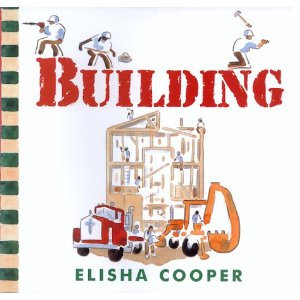
BUILDING

By Elisha Cooper

(Greenwillow Books, 1999)


There are many picture books that are breezy reads with cute illustrations, but they fade from memory shortly after closing them. A good book is one that lingers. Elisha Cooper's Building had me flipping back to reread fresh phrasing and peeking again at his simple, yet effective pencil sketches filled in with watercolors.


After reading the disappointing This is Daniel Cook at the Construction Site, I searched for a better book to captiure boys' fascination with construction. I'm a ferry ride away from a well-stocked bookstore so I had to settle for what I could find at my small, but vibrant local library. Building was a surprise discovery.


I'd anticipated coming across a loud book with big bold text matching photos of monster-sized bulldozers and cranes in action. Building is not that book. Instead, it is a quiet, reverant homage to the tasks and the workers in the construction industry, more real than any photojournalist's work.


The reader gets a full sense of the sounds, sights and feel of transforming a barren lot into a new building "waiting to be filled with people." The backhoe, cement truck and crane all get their due, but the construction workers earn the spotlight. Cooper's writing comes alive in the rich details. "Another worker smoothes the wet concrete. His hands are crusted in gunk and he has to use his wrist to push his glasses up to his nose." He compares a wheelbarrow of mortar to "a big tub of oatmeal." His portrayal of life on the work site includes the radio tunes that keep painters company ("Some days they hear the same song five times."), the choices during lunch and even mentions bathroom breaks ("[One worker] finds the Porta Potti."). Women work alongside men on site. ("[A]nother worker opens sawhorses, puts in her ear plugs and cuts boards for the first floor.")


Published a dozen years ago, I wonder if an editor would save a manuscript like this from a slush pile today. The language is not watered down for 4-6 year olds. While every word matters, the word count is high in the current 600-words-or-less picture book world. More allowance for nonfiction? Maybe, but Cooper's sentences contain clauses and are often metaphorical. ("With the skeleton of the building in place, the skin goes on.")


Perhaps to minimize language concerns, the text is creatively shaped and chunked. When an architect and workers survey the empty lot, the text crawls around the perimeter of the double-page spread. The text regarding the cement truck spills from the chute of a cement truck sketch and forms the rounded image of the drum.


As a read-aloud, this book will have more meaning through repeated reads over several years. I can also see it being used to teach descriptive writing in grades three and four, something to go along with literary examples of flower gardens and pristine lakes. Description is not just in the adjectives which are used sparingly in Building. The actions must be realistic and vivid. Kids will smile as they easily visualize passages like, "A contractor lugs toilets up stairs. She bumps into walls and can't see her feet." (Again, more toilet talk without the base humor.)


Elisha Cooper's Building makes a substantial addition to any picture book collection.

Monday, July 18, 2011

BOOKS ABOUT CONSTRUCTION


ARE YOU MY MOTHER?
By P.D. Eastman (Beginner Books, 1960) THIS IS DANIEL COOK AT THE CONSTRUCTION SITE Written by Yvette Ghione Illustrated and designed by Celeste Gagnon (Kids Can Press, 2007) It is often said that up until grade four children are "learning to read" while they are "reading to learn" from grade four onward. The statements are simplistic. I would think my first forays on the Internet as an adult constituted a new chapter in my own learning to read (How do I go back?! If there are 3,140,000 articles on "mosquito repellent"--you can tell where my mind's at today--, what should I click?). And, most definitely, young children are learning a great deal as they read or listen to early picture books. Still, the publishing industry (and many teachers) have stuck with the learning/reading dichotomy. Perhaps that's partly why it is more cumbersome to find a decent nonfiction picture book than a catchy, funny work of fiction. The first true "learning to read" book I recall from my childhood was P.D. Eastman's Are You My Mother? I have fond memories of the dopey little bird who falls out of its nest. Whenever I come across a worn copy in a library (with ample amounts of librarian's tape slathered here, there and everywhere), I stop and give it another read. The words are simple and repeated often to help the budding reader increase sight words and correctly guess words from sentence and story context. The illustrations are grey-brown with red and yellow accents. (The drawings of the kitten and the hen would never be considered gallery-worthy as many of today's figures in picture books. Dog and cow show more expression though proportions are not quite right.) None of that matters. It's the goofy, inquisitive bird that commands full attention. For me, the highlight of the story always comes down to little bird's "conversation" with the massive red machine, seemingly powered by no one. "Mother, Mother! Here I am, Mother!" gets the distinct reply, "Snort." I giggle at the silly bird and I love how the machine comes to the rescue. Forget humans and animals; machines can save the day! Vroom, vroom! I was intrigued by the title This is Daniel Cook at the Construction Site (when I did an unsuccessful library search for a current bestseller, Goodnight, Goodnight, Construction Site). The publisher, Kids Can Press, focuses on nonfiction so I grabbed the title to see how current nonfiction is designed to engage young (boy) readers, the kind of readers who find awe in the power of big machines. I typically only select books that I like for blogging. Let another online someone relish in not having something nice to say. This book would have been a pass, but I feature it for two reasons. First, I was troubled before opening the book. The only words on the cover and spine are the title. Wordless book? I peeked in; plenty of text. I cringe when an author fails to get due credit. The writer's name did not appear on the title page either. Writer Yvette Ghione and illustrator/designer Celeste Gagnon are only recognized in the fine print on the last page of the book. Oh, the injustice! My second quibble is that the book takes a subject of high appeal to many youngsters and does the old-fashioned nonfiction treatment, making the book a far distant cousin to Tonka gear and real construction sites. There are lots of curvy red arrows linking still photos to text but that's about all the bounce to be found in this book, part of a series based on the Canadian television show "This is Daniel Cook". The focus of the construction site, the making a new sidewalk, lacks the draw of a building demolition and a new skyscraper project or even the creation of a new house. And I shook my head when the writer twice compared framing the sidewalk and pouring cement to baking a cake. The comparisons were unnecessary and highlighted a lack of understanding for the audience. Not being awed by construction (now or ever), I did learn something from Daniel Cook. That Snort from Are You My Mother? I'd always referred to it as a bulldozer or a crane. Turns out I'm as silly as the bird. It's a backhoe. Go figure. Still, when given the choice between the classic fiction and the authentically photographed recent nonfiction, it still isn't a contest. Little bird and Snort win.